
China Travel Guide: Visa Rules for Americans, Best Time to Go, and Where to Start
When a U.S. passport needs a visa and when the 240-hour transit rule covers you, Beijing and Guilin weather month by month, bullet trains, and the local laws that catch visitors out.
- 240 hours visa-free, only when transiting to a third country
- 10 years: the multiple-entry tourist visa most U.S. citizens can apply for
- 819 miles of high-speed line from Beijing to Shanghai
For Americans, the first question about China is paperwork: most trips still need a visa, but a growing transit program lets you stop over for up to ten days on the way somewhere else. After that come the huge swings in climate between north and south, and a set of local rules, from carrying your passport at all times to staying off closed stretches of the Great Wall.
We built this guide on October 16, 2026, from the CDC’s China page, the Shanghai government’s summary of the National Immigration Administration’s transit policy (posted July 9, 2026), the French foreign ministry’s China advisory (updated September 15, 2026), World Meteorological Organization normals for Beijing and Guilin, and, added on October 22, 2026, the State Department, UNESCO, China’s Ministry of Culture and Tourism, and the Beijing and Shanghai city governments. It links to our Beijing, Shanghai, Xi’an, Guilin, and Hong Kong city guides.
Advised Traveler is free to use. If you find our content useful, you can support us by booking through our affiliate links: we earn a commission at no extra cost to you.
- Visa or 240-hour transit
- Best time to visit
- Where to go
- Trains and flights
- Safety and local laws
- Health and insurance
- Money, internet, eSIM
- Where to stay
- FAQ
- Sources
Do U.S. citizens need a visa for China?
For an ordinary vacation, yes: the United States is not on China’s list of countries exempt from visas for tourist stays. Most U.S. citizens can apply for a 10-year multiple-entry tourist (L) visa, according to the State Department. Apply through the Chinese embassy or a consulate well before you fly.
The exception is the 240-hour visa-free transit policy. U.S. citizens are among the 57 nationalities eligible, and the National Immigration Administration lets them enter through any of 65 designated ports and travel within the permitted areas of 24 provincial-level regions for up to 240 hours (10 days), including for tourism.
- Onward ticket: you need a confirmed seat and departure date to a third country or region. A round trip from the U.S. to China and straight back home doesn’t qualify.
- Purpose: tourism, business, and family visits are allowed; work, study, and reporting still require the right visa.
- Timing: the French advisory warns that overstaying a transit window, even because of a late flight, counts as a violation, so don’t book your exit at the last possible hour.
- Tibet: neither a visa nor transit entry is enough. A special permit arranged by a licensed agency is required, and a guide must accompany you.
On arrival: foreigners are photographed and fingerprinted at the border and must register with local police within 24 hours. Hotels do this for their guests; if you stay in a private home, it’s on you. The State Department rates mainland China Level 2, Exercise Increased Caution (advisory issued October 19, 2026), citing arbitrary enforcement of local laws, exit bans, and the risk of wrongful detention. It asks for a passport valid at least 6 months beyond your arrival date, with 2 blank pages.
Best time to visit China: spring and fall in the north, fall in the south
Beijing’s seasons are set by temperature. The average high is just 36°F in January and 89°F in July, and July alone brings about a third of the city’s 20.8 inches of yearly rain. April, May, September, and October, with highs from the upper 60s to about 80°F, are the comfortable months.
- Jan 20 / 36°F
- Feb 24 / 43°F
- Mar 35 / 56°F
- Apr 48 / 70°F
- May 59 / 81°F
- Jun 68 / 87°F
- Jul 73 / 89°F
- Aug 72 / 87°F
- Sep 61 / 80°F
- Oct 48 / 67°F
- Nov 33 / 51°F
- Dec 23 / 39°F
Beijing, average monthly low and high, World Meteorological Organization 1991-2020 normals. Dark blue: high below 50°F. Light blue: 50 to 67°F. Yellow: 68 to 81°F. Orange: 82°F and above.
| Month | Beijing | Guilin |
|---|---|---|
| Jan | 20 / 36°F, 0.1 in | 43 / 53°F, 2.7 in |
| Feb | 24 / 43°F, 0.2 in | 47 / 58°F, 3.3 in |
| Mar | 35 / 56°F, 0.3 in | 53 / 64°F, 6.0 in |
| Apr | 48 / 70°F, 0.9 in | 62 / 75°F, 8.9 in |
| May | 59 / 81°F, 1.4 in | 69 / 82°F, 12.6 in |
| Jun | 68 / 87°F, 2.9 in | 75 / 87°F, 17.7 in |
| Jul | 73 / 89°F, 6.7 in | 77 / 91°F, 10.5 in |
| Aug | 72 / 87°F, 4.5 in | 77 / 92°F, 5.8 in |
| Sep | 61 / 80°F, 2.1 in | 73 / 87°F, 3.2 in |
| Oct | 48 / 67°F, 1.1 in | 65 / 79°F, 2.2 in |
| Nov | 33 / 51°F, 0.5 in | 56 / 69°F, 3.2 in |
| Dec | 23 / 39°F, 0.1 in | 46 / 59°F, 2.1 in |
Guilin, in the south, is a different world: about 78 inches of rain a year, with 17.7 inches in June alone, against barely 2 inches in October and December, its driest months. Along the southern and eastern coast, from Zhejiang to Guangzhou, Hong Kong, and Macao, about ten typhoons strike in an average year, between May and November.
Where to go in China: Beijing, Shanghai, Xi’an, Guilin, and beyond
Beijing and Xi’an hold the imperial and ancient sites, Shanghai the colonial-era waterfront and the skyline, Guilin the karst scenery of the south. Each card links to our full guide where we have one.
Beijing: the Forbidden City and the Great Wall
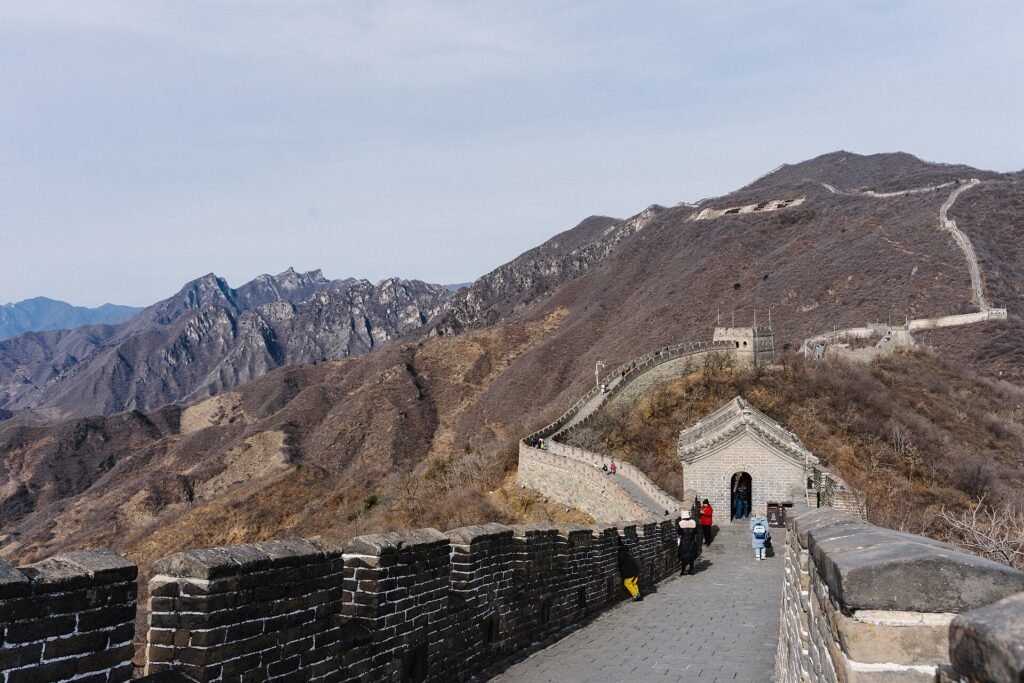
The Forbidden City, the imperial palace of the Ming and Qing dynasties, became a UNESCO World Heritage Site in 1987, as did the Great Wall; the Temple of Heaven and the Summer Palace followed in 1998. Water covers three-quarters of the Summer Palace’s roughly 290 hectares (about 1.1 square miles), per the Beijing city government. The Mutianyu section of the Great Wall lies northeast of the city. Our guide: Beijing.
Shanghai: the Bund and Pudong
On the west bank of the Huangpu River, the Bund lines up 52 Gothic and Baroque buildings that once housed the city’s financial firms and trading companies, per the Shanghai city government. Our guide: Shanghai.
Xi’an: the Terracotta Army
The Terracotta Army belongs to the mausoleum of Qin Shi Huang, the first emperor to unify China, a World Heritage Site since 1987. China’s Ministry of Culture and Tourism places it about 3.5 kilometers (2 miles) east of Lintong District, at the foot of Mount Li. Our guide: Xi’an.
Guilin, the Li River, and Yangshuo
The Lijiang (Li River) Scenic Zone at Guilin has been on UNESCO’s World Heritage Tentative List since 1996. Plan around the rain: this is the wettest stop in this guide, and fall is the driest season. Our guide: Guilin.
Chengdu and the giant pandas
The capital of Sichuan is home to the Chengdu Research Base of Giant Panda Breeding, in Chenghua District, which combines research, breeding, and visitor programs. Authorities can temporarily close the Tibetan areas of northern and western Sichuan (Ganzi, Aba, Litang) to foreigners, notably around Tibetan New Year.
Hong Kong and Macao
Both are special administrative regions with their own entry rules and laws. One that surprises visitors: since April 30, 2026, using or carrying e-cigarettes and vapes in public places is banned in Hong Kong. Our guide: Hong Kong.
A guided tour of the Forbidden City, a day trip to Mutianyu, or a Li River cruise: the button below opens our partner GetYourGuide’s listings across China. For the Great Wall, make sure the tour goes to a section officially open to visitors, since unrestored stretches are off limits and trespassers face heavy fines.
See all China tours and activities on GetYourGuide
Getting around China: bullet trains, domestic flights, and hired drivers
The Beijing to Shanghai high-speed line went into service in 2011, runs 1,318 kilometers (819 miles), and was designed for 350 km/h (about 217 mph), per state-owned China Railway International. Domestic flights are plentiful, but crowded airspace and unannounced military exercises regularly cause long delays.
Power banks: since June 28, 2025, only portable batteries marked with the CCC (China Compulsory Certification) logo are allowed on planes. Bag checks start at the airport entrance, and body searches can be thorough.
Driving yourself is rarely worth it on a short trip. Police checks are frequent, the drunk-driving threshold is 20 mg per 100 ml of blood, and penalties can include jail. Cars with drivers are common and inexpensive in the big cities, which is the option the French advisory recommends.
Is China safe? Restricted areas and the laws that trip up visitors
The French advisory rates the terrorism risk as very low and places the whole country on normal alert except the Xinjiang Uyghur Autonomous Region, where foreigners face systematic checks and only a few hotels may host them. Several districts of Qinghai and Inner Mongolia are closed to foreigners. Earthquakes are a real risk, notably in Sichuan, Yunnan, and the Beijing area.
- Passport: carry the original at all times, since police ask for it at checks, and keep a copy somewhere safe.
- Drugs: zero tolerance, cannabis and CBD products included, in Hong Kong and Macao as well. Sentences can go as far as the death penalty.
- Photos and drones: no pictures near official or military sites. Drones must be declared at customs and registered; in Beijing, unregistered drones are banned outright.
- Customs: declare foreign currency worth $5,000 or more, or over 20,000 yuan. Meat, dairy, eggs, and fresh fruit can’t be brought in, and antiques can’t be taken out.
- Emergencies: police answer at 110, with English-speaking officers.
Keep arguments cool: a dispute with a taxi driver or another motorist can escalate quickly into prolonged detention or a heavy fine. If you are assaulted, call 110 right away and, if you can, film the people involved.
Health and travel insurance for China
The CDC asks every international traveler to be fully vaccinated against measles. For China, it recommends hepatitis A for unvaccinated travelers age 1 and older and hepatitis B for unvaccinated travelers of all ages. Japanese encephalitis vaccine is for longer stays or rural trips, not short city visits, and typhoid is worth considering. Rabid dogs are common, so avoid animals.
Flying direct from the U.S., you need no yellow fever certificate; coming from a country with yellow fever risk, including a layover longer than 12 hours there, you do, unless your trip is limited to Hong Kong or Macao. In Beijing and other northern cities, air quality can exceed an index of 300 on bad days: pack N95 masks. Above about 8,200 feet, in Tibet for instance, climb slowly to avoid altitude sickness.
Before you go, ask your health plan what it covers overseas, including evacuation. Our partner SafetyWing Nomad Insurance lists up to $250,000 in medical coverage and a $100,000 lifetime maximum for medical evacuation; its quote page tells you if you are eligible. Readers living in Europe can look at Chapka Cap Assistance.
SafetyWing code: if you have never had a SafetyWing account, enter ADVISEDTRAVELER to get the Electronics Theft add-on free for 8 weeks on a Nomad Essential plan billed every 28 days or yearly. Click the pink camera icon on the Nomad Insurance page and add the code before you create your account. After 8 weeks the add-on renews as a paid option.
Money, the Great Firewall, and an eSIM for China
China’s currency is the renminbi, counted in yuan. Keep some cash apart from your cards in case either is lost or stolen: cash transfers such as Western Union can only be paid into a bank account opened in China.
Some foreign websites and apps may not work from China, so download the apps, maps, and documents you’ll need before you leave. For mobile data, our partner Yesim sells a China eSIM you can install at home on an unlocked, eSIM-ready phone. It’s also worth asking your U.S. carrier what its international day pass costs in China.
Where to stay in China: registered hotels in the big four cities
Staying in a hotel takes care of police registration for you, which a private rental may not. In Xinjiang, only a few hotels are licensed to take foreign guests. The map opens on Beijing; type Shanghai, Xi’an, or Guilin into its search box to move it.
Compare places to stay in China, with recent prices and reviews
China travel FAQ
Can Americans visit China without a visa?
Only in transit: the 240-hour policy allows up to 10 days without a visa if you hold a confirmed onward ticket to a third country or region. A regular vacation needs an L (tourist) visa.
How long is a Chinese tourist visa valid for U.S. citizens?
Most U.S. citizens can apply for a 10-year multiple-entry tourist visa, per the State Department. The consulate decides the validity and length of stay it grants.
When is the best time to visit China?
For Beijing and the north, April to May and September to October, with highs of about 67 to 81°F. For Guilin, fall, when rainfall drops to about 3 inches a month or less.
How long is the train from Beijing to Shanghai?
It depends on the train, so check the timetable on China Railway’s official ticketing service. The high-speed line runs 819 miles and was designed for 350 km/h (about 217 mph).
Will my usual apps and websites work in China?
Not necessarily: some foreign websites and apps may be unavailable. Set up offline maps and download what you need before departure.
Can you hike any part of the Great Wall?
No. In Beijing municipality and several provinces, only sections officially open to tourists may be visited; unrestored stretches are closed, and fines are heavy.
Sources
Checked on October 16, 2026, and October 22, 2026.
- Centers for Disease Control and Prevention, China, Traveler View (yellow fever entry rules updated April 23, 2025).
- Shanghai Municipal People’s Government, 240-hour visa-free transit policy (from the National Immigration Administration, July 9, 2026).
- French Ministry for Europe and Foreign Affairs, China advisory (in French, updated September 15, 2026): Security (alert zones updated March 5, 2026), Entry, Health, Practical information.
- World Meteorological Organization, 1991-2020 climate normals for Beijing and Guilin (files hosted by NOAA), converted and rounded.
- U.S. Department of State, China Travel Advisory (issued October 19, 2026) and China country information (entry requirements), checked October 22, 2026.
- UNESCO World Heritage Centre, China’s properties and Tentative List; China’s Ministry of Culture and Tourism, Mausoleum of Qin Shi Huang; Beijing city government, Summer Palace; Shanghai city government, the Bund; checked October 22, 2026.
- Chengdu Research Base of Giant Panda Breeding, About, and China Railway International, Beijing-Shanghai high-speed railway, checked October 22, 2026.
- SafetyWing, Nomad Insurance (coverage limits).
Researched and written by the Advised Traveler team from the sources listed, with no trip of our own behind it. Transit rules and visa terms change often, so confirm them with the Chinese embassy and the State Department shortly before you fly. Spotted an error? Let us know.