
Conakry, Guinea: Neighborhoods, Weather, Entry Rules and Safety
What the State Department, Guinea’s visa portal and local sources say, in one place: safety, visa, health, weather and where to stay.
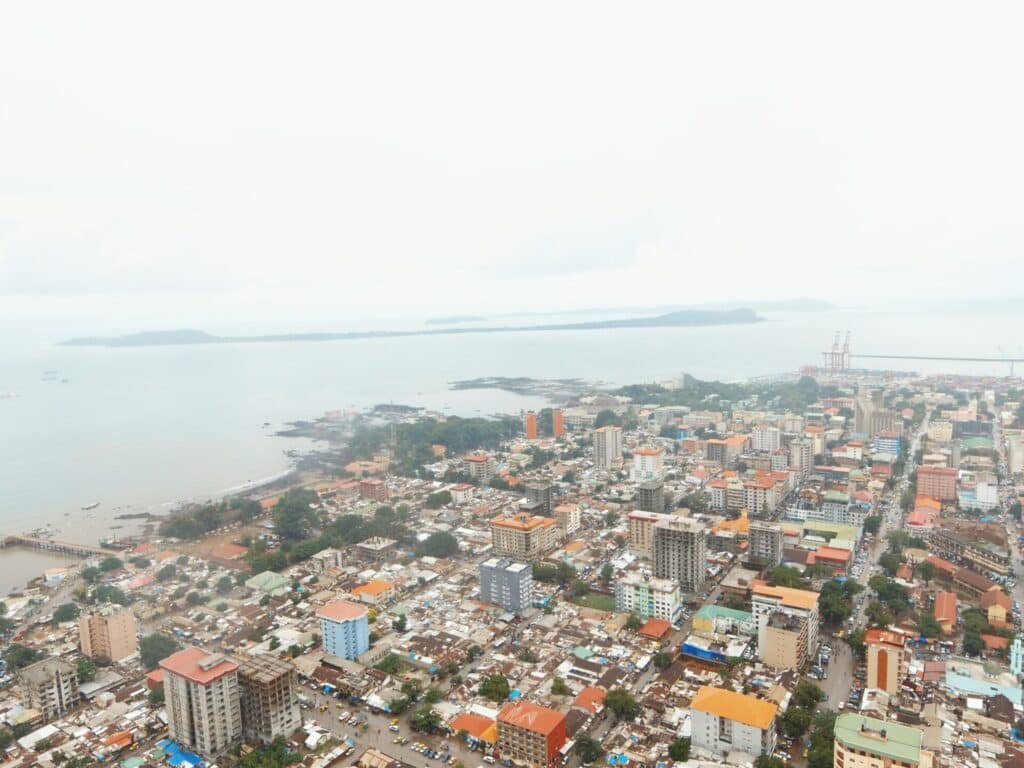
- Level 2 State Department advisory
- $100 tourist visa, applied for online
- Dec to Apr dry season, under 1 inch of rain a month
- 8 miles from the airport to downtown
Conakry is the capital of Guinea, in West Africa, built on a peninsula that juts into the Atlantic. The US State Department rates Guinea Level 2, “Exercise increased caution,” and a visa and a yellow fever certificate are both required to enter.
This page pulls together what official and local sources say, as checked on October 10, 2026: safety, entry rules, health, month-by-month weather, how the city is laid out, where the main hotels are and how to get around.
Advised Traveler is free to use. If you find our content useful, you can support us by booking through our affiliate links: we earn a commission at no extra cost to you.
Conakry at a glance
- Travel advisory: Level 2, Exercise increased caution (crime, unrest, health), issued February 25, 2026.
- Passport: valid at least six months beyond arrival, with one blank page.
- Health: yellow fever certificate required; malaria risk nationwide, year-round.
- Airport: Ahmed Sékou Touré International (CKY).
- Money: Guinean franc (GNF), in a cash-based economy.
- Power: 230 V, 50 Hz, type C and F plugs. US devices need an adapter, and single-voltage ones a converter.
- Population: about 3.4 million (2025 census, preliminary results), in 13 communes.
- Safety
- Visa and entry
- Health
- Weather by month
- Neighborhoods
- Where to stay
- Things to see
- Airport and transportation
- Money and power
- FAQ
- Sources
Is Conakry safe? What the State Department says
The US State Department’s advisory for Guinea is Level 2, “Exercise increased caution in Guinea due to crime, unrest, and inadequate health infrastructure.” It was issued on February 25, 2026, with no change of level, and the travel guidance was last updated on April 30, 2026. Level 2 is the second of four levels.
- Crime: crimes of opportunity are common, especially in Conakry: pickpocketing, purse snatching, vehicle theft, assaults and residential burglaries. Foreigners are targeted in crowded areas, in markets and when leaving the airport.
- Demonstrations: they can start without warning and turn violent. Security forces may use tear gas and gunfire. Avoid crowds.
- After dark: avoid walking alone at night or in isolated areas. Police and military roadblocks are common, particularly from 10 p.m. to 6 a.m., and some demand money.
- At the airport and hotels: decline uninvited offers of help and arrange to be met by hotel staff or a business contact.
- In a car: keep doors locked and windows mostly up.
- Photos: photographing government buildings and guarded sites without permission is illegal.
- Documents: carry a photocopy of your passport and visa.
In an emergency: dial 117. The US Embassy is at Transversale No. 2, Centre Administratif de Koloma, in the commune of Ratoma: main line +224-655-10-40-00, after-hours emergency line +224-629-00-07-01. Conditions change, so reread the Guinea travel advisory shortly before you leave.
Visa and entry requirements for US citizens
US citizens need a visa, and it has to be requested online before travel through the Republic of Guinea visa website. Fees shown on the site on October 10, 2026:
- tourist visa, up to 90 days: $100;
- transit visa, up to 3 days: $50;
- long-term visa, valid 1 year: $500.
The site states that the fee is kept even if the visa is denied. It does not give a processing time, so apply well ahead.
What you need: a passport valid for six months beyond your arrival with one blank page, a scan of the data page, a return ticket and your yellow fever certificate. Once the application is approved, you receive an entry visa letter. On arrival you show it with proof of lodging, then have your photo and fingerprints taken at the enrollment desk.
Customs limits: up to $10,000 or equivalent on entry, and no more than 1,000,000 GNF on exit. The State Department notes that travelers without a valid visa may be fined about $50 on departure.
Health: yellow fever, malaria and medical care
A yellow fever certificate (the “yellow card”) is required to enter Guinea, for travelers aged 9 months and older. Malaria is a risk throughout the country, and the State Department reports that the CDC recommends antimalarial medication for all travelers, including on short stays.
- Water: tap water is not safe to drink. Use sealed bottled water and skip the ice.
- Medical care: facilities are limited and poorly equipped, and medications can be in short supply or of doubtful quality. Hospitals usually require payment up front, mostly in cash.
- Ambulances: they are unreliable and not staffed with paramedics. In an emergency, a taxi or private car to the nearest major hospital may be faster.
- Insurance: Medicare, Medicaid and most US health plans do not cover care abroad. The State Department strongly recommends supplemental insurance that includes medical evacuation.
For vaccine recommendations and current health notices, see the CDC page for Guinea and a travel clinic at least a month before departure.
Travel medical insurance with evacuation cover
Our partner SafetyWing sells Nomad Insurance Essential, a travel medical plan billed every 4 weeks. Its plan page lists up to $250,000 for medical treatment and hospitalization and up to $100,000 over a lifetime for emergency evacuation. Pre-existing conditions, maternity care and cancer treatment are excluded, and cover during visits to your home country is limited. Check the full policy and your eligibility on the quote page before you buy.
Reader reward: if you have never had a SafetyWing account, the code ADVISEDTRAVELER adds 8 weeks of the Electronics Theft add-on at no charge on 28-day subscription or annual Nomad Essential plans. Click the pink camera on the Nomad Insurance page and enter the code before you create your account. After 8 weeks the add-on renews as a paid option unless you remove it.
If you live in Europe, Chapka’s Cap Assistance 24h/24 is an alternative. It is not available to US citizens or residents.
Conakry weather by month
The dry season runs from December through April, with less than 1 inch of rain a month and highs around 89 to 90 °F. Rain builds in May and peaks in July and August, when each month brings more than 42 inches over 26 to 28 rainy days. Conakry gets about 147 inches of rain a year.
- Jan 0.1 in
- Feb 0.1 in
- Mar 0.1 in
- Apr 0.7 in
- May 4.4 in
- Jun 17.1 in
- Jul 42.6 in
- Aug 45.0 in
- Sep 21.9 in
- Oct 11.5 in
- Nov 3.2 in
- Dec 0.2 in
Average rainfall by month. Yellow: under 2.4 inches. Light blue: 2.4 to 12 inches. Dark blue: more than 12 inches.
| Month | Low / high | Rain (rainy days) |
|---|---|---|
| January | 72 / 89 °F | 0.1 in (< 1) |
| February | 74 / 89 °F | 0.1 in (< 1) |
| March | 75 / 90 °F | 0.1 in (< 1) |
| April | 76 / 90 °F | 0.7 in (2) |
| May | 76 / 89 °F | 4.4 in (9) |
| June | 75 / 87 °F | 17.1 in (19) |
| July | 74 / 84 °F | 42.6 in (26) |
| August | 74 / 83 °F | 45.0 in (28) |
| September | 74 / 85 °F | 21.9 in (23) |
| October | 74 / 87 °F | 11.5 in (17) |
| November | 75 / 89 °F | 3.2 in (5) |
| December | 74 / 89 °F | 0.2 in (< 1) |
These rounded figures are 1991-2020 climate normals (30-year averages published by NOAA for the World Meteorological Organization), not a forecast. A rainy day is one with at least 0.04 inch of rain. Temperatures barely move during the year, so rain is what separates the seasons.
What it means on the ground: the State Department warns that flash floods in the rainy season, which it places from May to October, can make some roads impassable.
How Conakry is laid out: communes and neighborhoods
Conakry has 13 communes: Kaloum, Dixinn, Matam, Ratoma, Matoto, Kassa, Gbessia, Tombolia, Lambanyi, Sonfonia, Kagbélen, Sanoyah and Manéah. There were six until a law passed on January 18, 2024 split Matoto and Ratoma into three communes each and added three more on the edge of the city. Many maps and websites still show the older five- or six-commune layout.
The city runs in a line from the tip of the peninsula to the mainland, so it helps to think of it from southwest to northeast.
- Kaloum: downtown, at the tip of the peninsula, covering about 2 square miles. Government offices, ministries, banks, embassies, the port, Ignace Deen Hospital and the Sandervalia National Museum are here. Its neighborhoods include Almamya, Boulbinet, Coronthie, Sandervalia, Témitaye and Tombo.
- Dixinn: just north of downtown, home to the University of Conakry and many embassies. Camayenne, Bellevue, Landréah and Minière are among its 22 neighborhoods. The Grand Mosque is in this area, next to Donka Hospital.
- Ratoma: the north shore. Its neighborhoods include Kipé, Taouyah, Kaporo, Koloma and Hamdallaye. The US Embassy is in Koloma, and two international chain hotels are in Kipé.
- Matoto, Gbessia and Tombolia: the southeastern side of the city. The airport is in Gbessia.
- Kassa: an island commune in the Loos archipelago, 2.8 miles offshore.
- Lambanyi, Sonfonia, Kagbélen, Sanoyah and Manéah: the outer communes, on the north shore and the mainland side.
Where to stay in Conakry: three areas with international hotels
International chain hotels cluster in three waterfront areas: Kaloum, Camayenne and Kipé. Pick by where you need to be, because traffic between the tip of the peninsula and the north of the city is heavy at rush hour.
Before you book: the State Department advises arranging an airport pickup through your hotel, so check that yours offers one.
Kaloum, for meetings downtown
This is the closest area to ministries, banks and the port, and the farthest from the airport. The Noom Hotel Conakry sits on the waterfront in the Témitaye neighborhood, with 187 rooms, about 7 miles from the airport.
Camayenne, a 12-minute walk from the Grand Mosque
On Dixinn’s north corniche, the Palm Camayenne is on the water, 0.6 mile from the Grand Mosque and 1.4 miles from the Palais du Peuple. The area sits between downtown and the northern neighborhoods.
Kipé, the large oceanfront hotels of the north shore
Two large properties face the ocean here. The Sheraton Grand Conakry, opened in December 2016, has 269 rooms and suites. The Radisson Blu Hotel, Conakry lists 282 rooms, suites and apartments, 3.2 miles from the airport, or about 25 minutes by car according to the hotel. The US Embassy, in Koloma, is in the same commune.
The map below shows available hotels and apartments across the city, with rates for your dates.
See recent prices and reviews for Conakry hotels
Things to see in Conakry and nearby
Most sights are in Kaloum and around the Grand Mosque, within a few miles of each other.
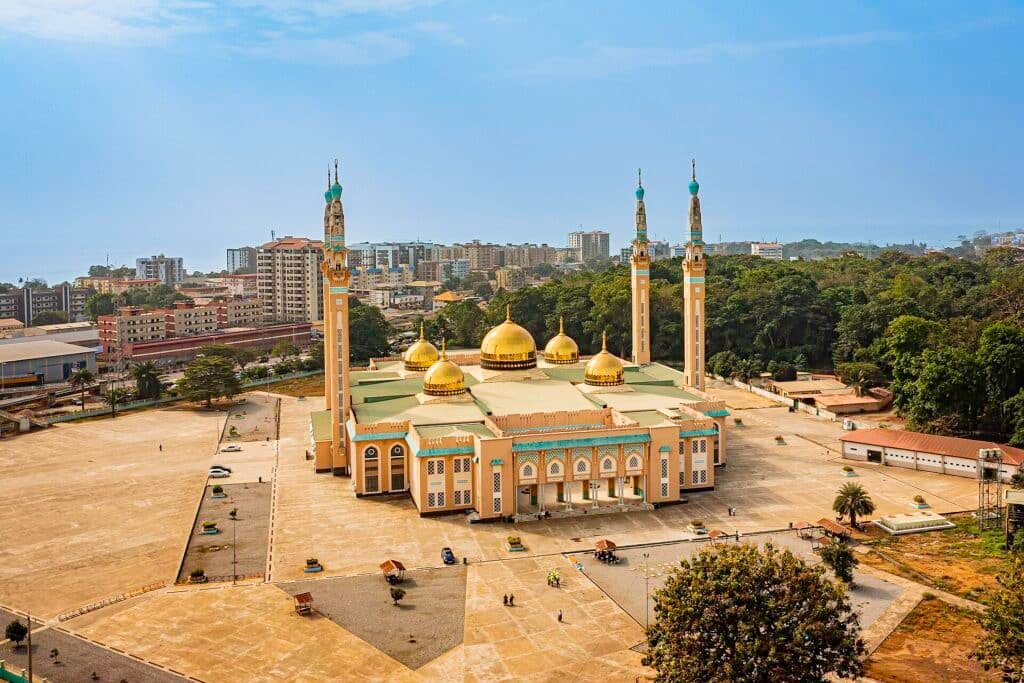
- Grand Mosque of Conakry (next to Donka Hospital): opened in 1982 with Saudi funding, it holds 10,000 men and 2,500 women inside, plus 12,500 worshippers on the esplanade. It is described as the largest mosque in sub-Saharan Africa. The Camayenne Mausoleum in its gardens holds the tombs of Samori Ture, Ahmed Sékou Touré and Alfa Yaya.
- Sandervalia National Museum (Kaloum): founded in 1960, with archaeology and ethnography collections.
- Conakry Botanical Garden (west of the Grand Mosque): established in 1894 and known for its kapok trees.
- Palais du Peuple: opened in 1967, a performance hall that also hosts major political events.
- Monument du 22 Novembre 1970: commemorates the attack on the city on November 22, 1970.
- St. Mary’s Cathedral: Conakry’s Catholic cathedral.
Hours and admission: none of the official sources we checked publishes them, so we do not list any. Confirm them locally or through your hotel.
The Loos Islands, under 9 miles offshore
The Loos archipelago (Îles de Los) faces the peninsula: Kassa is 2.8 miles from Conakry, Roume 7 miles and Tamara between 5.5 and 9 miles. You get there by boat or by large wooden canoe, and there are no roads or cars on the islands. Three islets have formed a marine sanctuary since 1992, protecting green sea turtles among other species.
The sources we checked give no schedules or fares for the crossing: have your hotel confirm them, and expect rougher seas in the rainy season.
Kindia and the hills inland
Kindia is 84 miles from Conakry, near Mount Gangan (3,665 ft). Closer to the capital, Mount Kakoulima (3,317 ft) rises north of the city, and the Soumba waterfalls past Dubréka are about a two-hour drive. The State Department advises against driving at night outside populated areas, so plan these as daytime trips.
Tours and day trips you can book ahead
The activities below come from our partner GetYourGuide. Before you book a Loos Islands outing or a city tour, check the meeting point, the guide’s language and the cancellation terms.
See all Conakry activities on GetYourGuide
Flying into Conakry and getting around
Ahmed Sékou Touré International Airport (CKY), renamed in December 2021, is in Gbessia, about 8 miles northeast of downtown. None of the routes listed for the airport is a US nonstop, so plan on one connection.
Airlines listed as serving it include Air France from Paris, Brussels Airlines from Brussels, Royal Air Maroc from Casablanca, Turkish Airlines from Istanbul, Emirates from Dubai and Ethiopian Airlines from Addis Ababa. Schedules change, so check with the airline.
- Airport transfer: book it through your hotel before you land.
- Taxis: the State Department describes them as often poorly maintained and erratically driven, and US government employees are not permitted to use them. Cars with drivers can be hired through agencies at the major hotels.
- Public transportation: limited, unreliable and often overcrowded.
- Driving: roads are poorly maintained and often unlit, and roadside assistance does not exist.
- Conakry Express commuter train: Guinea’s transport minister said in July 2026 that it runs only “very sporadically.” A relaunch is under study. Do not plan around it.
Money, power and staying connected
- Cash: the Guinean franc (GNF) is the currency and most payments are in cash. ATMs in Conakry accept US bank cards but are not always reliable, and credit cards are taken only at some larger hotels and supermarkets.
- Power: 230 V at 50 Hz, with type C and F outlets (two round pins). Bring a plug adapter, and check that your chargers are rated 100-240 V.
- Mobile data: an eSIM saves you from hunting for a SIM card on arrival. Our partner Yesim sells data plans by country: check on its site that Guinea is covered, and at what price, before you buy.
- Language: French is the official language.
Frequently asked questions about Conakry
Is Conakry safe for American travelers?
The State Department rates Guinea Level 2, Exercise increased caution, because of crime, unrest and limited health infrastructure. Crimes of opportunity are common in Conakry, and demonstrations can turn violent without warning.
Do US citizens need a visa for Guinea?
Yes. The visa is requested online before travel on the Republic of Guinea visa website. A tourist visa of up to 90 days costs $100, and your passport must be valid for six months beyond arrival.
Is the yellow fever vaccine required for Guinea?
Yes. An International Certificate of Vaccination is required for travelers aged 9 months and older, and it is one of the documents requested with the visa application.
When is the best time to visit Conakry?
December through April. The 1991-2020 climate normals show less than 1 inch of rain per month in that period, compared with more than 42 inches in July and again in August.
What airport do you fly into for Conakry?
Ahmed Sékou Touré International Airport, code CKY, about 8 miles from downtown. There is no US nonstop among its listed routes.
Can you drink the tap water in Conakry?
No. The State Department says tap water is not safe to drink and advises sealed bottled water and no ice.
How many communes does Conakry have?
Thirteen since a law passed on January 18, 2024: Kaloum, Dixinn, Matam, Ratoma, Matoto, Kassa, Gbessia, Tombolia, Lambanyi, Sonfonia, Kagbélen, Sanoyah and Manéah.
Sources
All sources were checked on October 10, 2026. Where we could not verify a detail, we say so in the text instead of publishing it.
- US Department of State: Guinea travel advisory and Guinea country information (safety, entry, health, transportation, money).
- Republic of Guinea visa website (border police, DCPAF): visa types, fees, documents and procedure.
- Guinéenews (in French): the January 18, 2024 law creating new communes, municipal election results in Conakry’s 13 communes (June 5, 2026), status of the Conakry Express train (July 27, 2026).
- Wikipedia: Conakry for NOAA 1991-2020 climate normals and the 2025 census; Grand Mosque of Conakry; Ahmed Sékou Touré International Airport; in French, Kaloum, Dixinn, Ratoma, Îles de Loos and Kindia for neighborhoods, places and distances.
- Wikivoyage, Conakry: botanical garden, Soumba waterfalls.
- World Standards: plugs and voltage.
- SafetyWing, Nomad Insurance: coverage limits and exclusions of the Essential plan. Reward terms as provided to us by SafetyWing.
- Hotels: Hospitality ON (in French) for the Sheraton Grand Conakry, Radisson Hotels for the Radisson Blu, the Hotels.com listing for Palm Camayenne, the Successful Meetings listing for Noom Hotel Conakry.
Related: our Africa pages and guides and, for the neighboring capital, our Bissau page.
Written by the Advised Traveler team. Fees, entry rules and safety guidance can change: confirm them with the sources above before you travel. Spotted an error? Let us know.