
Greece Travel Guide: Entry Rules for Americans, Islands vs. the Mainland, Summer Heat, and Ferries
The new EU border system and what ETIAS means for U.S. passport holders, our nine Greece destination guides by region, Athens weather month by month, and the rules that catch visitors out.
- 90 days visa-free in any 180
- 91°F average July high in Athens
- 10.4 million residents
- 21 UNESCO World Heritage Sites
Greece had 10.4 million residents on January 1, 2025, according to its statistics authority, ELSTAT. The currency is the euro, and the country is part of the Schengen Area, which sets the rules for how long Americans can stay.
This page links to every Greece guide on our site. Entry rules come from the European Commission and Greece’s Ministry of Foreign Affairs, health advice from the CDC, climate normals from the National Observatory of Athens, and safety and transport detail from the French foreign ministry’s advisory, updated September 15, 2026. Everything was checked on October 16 and 20, 2026.
Advised Traveler is free to use. If you find our content useful, you can support us by booking through our affiliate links: we earn a commission at no extra cost to you.
- Visa, EES, and ETIAS
- Where to go: our guides
- Weather by month
- Ferries, trains, and driving
- Health and insurance
- Money, data, and local laws
- Where to stay
- FAQ
- Sources
Do Americans need a visa for Greece? Entry rules for 2026
No visa is needed for tourism. U.S. citizens can stay up to 90 days within any 180-day period, and that count covers the whole Schengen Area, not just Greece. Days spent in Italy or France before a Greek island hop use up the same allowance.
- EES: the EU’s Entry/Exit System, an automated register of non-EU visitors on short stays, started on October 12, 2025 and became fully operational on April 10, 2026. Expect your entry and exit to be recorded electronically at the border.
- ETIAS: the planned travel authorization for visa-exempt visitors is not running yet, and no applications are being taken. The European Commission says it will announce the start date several months ahead; the fee has been set at €20.
Passport validity: check the minimum the State Department asks for Greece on its country page, and beware of sites offering paid “ETIAS applications” while the system is not open.
Where to go in Greece: six regions and our destination guides
We have guides for Athens, three mainland sites, Thessaloniki, and four islands. None has been rebuilt with dated sources yet; Heraklion is first in line.
Athens
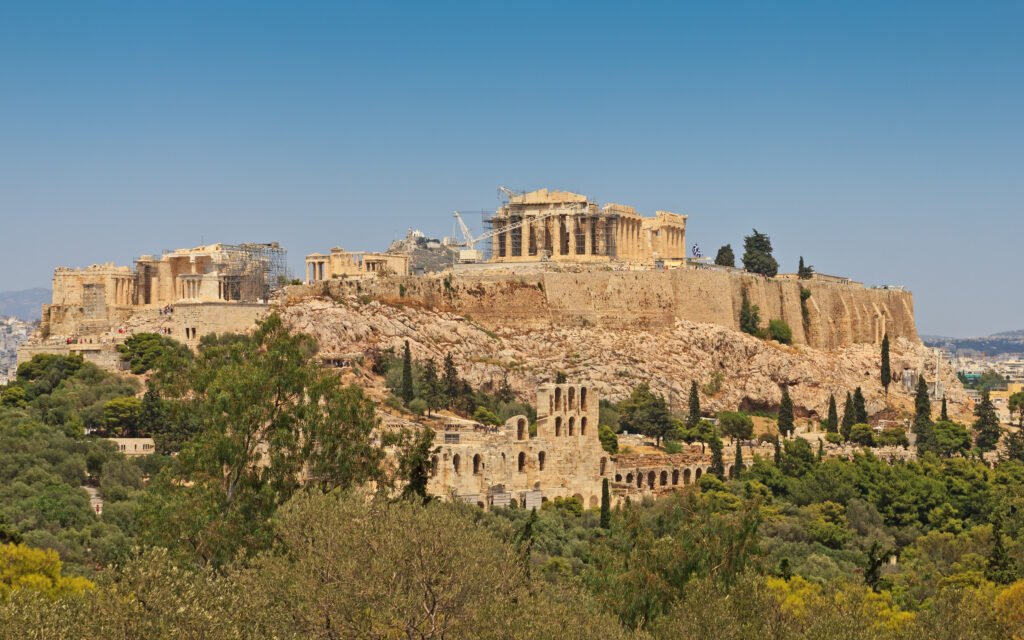
Guide: Athens. The Acropolis is a World Heritage Site. Pickpocketing is common around it, in Monastiraki, on Philopappos Hill, around Omonia Square, and on the metro to and from the airport, the French ministry warns.
Delphi, Meteora, and Nafplio
Guides: Delphi, Meteora, and Nafplio. Meteora’s cliff-top monasteries are listed by UNESCO for both nature and culture, and a rail line runs from Athens to Kalambaka at their foot. Mycenae, Tiryns, and Epidaurus, all within reach of Nafplio, are World Heritage Sites too.
Thessaloniki and the north
Guide: Thessaloniki, roughly five and a half hours from Athens by train. Its early Christian and Byzantine churches are on the UNESCO list. Demonstrations are frequent around Aristotelous Square and Egnatia Avenue; steer clear of them.
Santorini, Mykonos, and the Cyclades
Guides: Santorini and Mykonos. Santorini sits on one of Greece’s two active volcanoes, the other being Nisyros. The sacred island of Delos, in the same archipelago, is a World Heritage Site.
Crete
Guide: Heraklion. In 2025, UNESCO inscribed six Minoan palace sites on the island, including Knossos and Phaistos. Greece has a high rate of fatal road crashes, and the French ministry singles out Crete, so drive a rental car with care.
Rhodes and the Dodecanese
Guide: Rhodes. The walled Medieval City of Rhodes, built up by the Knights of St. John, has been a World Heritage Site since 1988.
For an Acropolis tour, a Delphi day trip, or a boat outing from Santorini, the button below opens our partner GetYourGuide’s Greece listings. In July and August, prefer early starts: the French ministry advises postponing strenuous outings during heat waves.
See Greece tours and activities on GetYourGuide
Best time to visit Greece: heat matters more than rain
Athens gets most of its rain from November through March, and summer is nearly dry, with under half an inch a month from June through August. Average highs pass 84°F from June through September and sit between 69 and 78°F in April, May, and October.
- Jan 44 / 55°F
- Feb 44 / 56°F
- Mar 47 / 61°F
- Apr 53 / 69°F
- May 60 / 78°F
- Jun 68 / 86°F
- Jul 73 / 91°F
- Aug 72 / 90°F
- Sep 67 / 84°F
- Oct 59 / 74°F
- Nov 53 / 65°F
- Dec 47 / 58°F
Average low and high by month at the National Observatory of Athens, 1961-1990 normals published by the Observatory. Dark blue: high below 50°F. Light blue: 50 to 67°F. Yellow: 68 to 81°F. Orange: 82°F and above.
| Month | Low / high | Rain |
|---|---|---|
| Jan | 44 / 55°F | 1.8 in |
| Feb | 44 / 56°F | 1.9 in |
| Mar | 47 / 61°F | 1.7 in |
| Apr | 53 / 69°F | 1.1 in |
| May | 60 / 78°F | 0.7 in |
| Jun | 68 / 86°F | 0.4 in |
| Jul | 73 / 91°F | 0.2 in |
| Aug | 72 / 90°F | 0.2 in |
| Sep | 67 / 84°F | 0.5 in |
| Oct | 59 / 74°F | 1.9 in |
| Nov | 53 / 65°F | 2.0 in |
| Dec | 47 / 58°F | 2.6 in |
Averages hide the peaks: summer temperatures regularly top 104°F, sometimes in the mountains too, and summer is also wildfire season. Greece’s civil protection agency publishes a daily fire-risk map, and emergency alerts go out by location-based text message (GR-Alert, in Greek and English), so keep location services on.
Good to know: these normals are for Athens only. We did not find island or Crete series covering the same period, so check each destination guide.
Getting around Greece: ferries, buses, trains, and rental cars
Ferries are the backbone of island travel, and the French ministry rates their safety as meeting international standards. Strong winds can cancel or delay sailings, and fast boats are the roughest ride in choppy seas. Build a buffer day before your flight home.
- Buses: an extensive, good-quality network reaching nearly every mainland city and the larger islands.
- Trains: a small network. The main lines link Athens with Thessaloniki (about 5.5 hours), Kalambaka for Meteora, Volos, and Chalkida.
- Driving: cars must carry a warning triangle, a first-aid kit, and a fire extinguisher. The legal blood-alcohol limit is 0.05%, and 0.02% for motorcyclists and new drivers. After a crash involving another party, a police report is mandatory or insurers will not pay.
- Rentals: avoid small unlicensed agencies on the islands; some companies will not rent to drivers over 70. ATVs cause serious crashes every year, and helmets are mandatory on all two-wheelers and ATVs.
- Flights: Athens airport has frequent summer delays and late baggage. Keep any medication in your carry-on.
Health care, vaccines, and travel insurance for Greece
The CDC asks all international travelers to be fully vaccinated against measles. It recommends hepatitis B for unvaccinated travelers under 60 and suggests considering hepatitis A, especially for trips to villages and rural areas. In summer 2026, Greek authorities reported a rise in West Nile virus cases in Attica and the north, the French ministry notes; there is no vaccine, so use repellent.
Tap water is generally safe to drink, except in remote areas and on some islands. Hospital care is good in Athens and Thessaloniki only; elsewhere, and especially on the islands, a serious case may mean an evacuation to the capital.
That is why medical evacuation coverage matters here. Our partner SafetyWing Nomad Insurance lists a $250,000 maximum for medical treatment and $100,000 lifetime for evacuation to a better-equipped hospital; check eligibility for your state on the quote page.
Reader perk: new SafetyWing customers on a Nomad Essential plan (28-day subscription or annual) can enter the code ADVISEDTRAVELER for 8 weeks of the Electronics Theft add-on. Click the pink camera icon on the Nomad Insurance page and enter the code before creating your account. After 8 weeks, the add-on renews as a paid option. If you live in Europe, Chapka Cap Assistance is another option; it is not open to U.S. residents.
Earthquakes are frequent across the country. After strong shaking on the coast, watch for official tsunami alerts. The European-Mediterranean Seismological Centre reports quakes in near real time on its site and app.
Money, phone data, and Greek laws that surprise visitors
Greece uses the euro. Cards are accepted in most shops, hotels, restaurants, and gas stations, even for small amounts, though some places on small islands have no card reader, so carry a little cash.
Before you fly: check what your U.S. carrier charges for data in Greece. Our partner Yesim sells a Greece eSIM you can install at home, handy for ferry tickets and maps on your phone.
- Antiquities: taking an ancient object out of Greece can mean one month to five years in prison and a heavy fine. Merely possessing one you have not declared to the authorities can lead to prosecution.
- Knives and pepper spray: pocketknives and pepper spray count as weapons, and arrests for carrying them happen regularly.
- Drugs: sentences range from 3 to 20 years, including for so-called soft drugs.
- Churches: modest clothing that covers up is required.
- ID checks: police check papers, especially in central Athens, so carry valid identification.
Where to stay in Greece
Each region card above links to hotels in its main town. The map below opens on Athens; type Santorini, Heraklion, or Rhodes in its search box to move it. If your plan strings several ferries together, staying near the port makes early departures simpler.
Browse places to stay in Greece with current prices and reviews
Things to know before visiting Greece: FAQ
Do U.S. citizens need a visa for Greece?
No, not for tourism. Americans can stay up to 90 days in any 180-day period across the whole Schengen Area.
Do I need ETIAS to visit Greece?
Not yet. As of October 16, 2026, ETIAS is not operating and no applications are accepted. The European Commission will announce the launch date months in advance; the fee will be €20.
Is it safe to travel to Greece?
The French ministry puts the whole country at its lowest alert level. The main issues are pickpocketing in Athens, road safety, summer wildfires, and earthquakes.
Can you drink the tap water in Greece?
Generally yes, except in remote areas and on some islands. Ask locally if you are unsure.
What is the best month to visit Athens?
April, May, and October, with average highs of 69 to 78°F. From June through September, highs average 84 to 91°F.
How long is the train from Athens to Thessaloniki?
About five and a half hours, via Larissa, according to the French ministry’s transport notes.
Sources
Pages checked on October 16, 2026; Greek Foreign Ministry, National Observatory of Athens, ELSTAT, and UNESCO sources checked on October 20, 2026.
- European Commission, Migration and Home Affairs: Entry/Exit System (fully operational April 10, 2026) and ETIAS (not yet in operation, €20 fee).
- Centers for Disease Control and Prevention, Greece, Traveler View (measles, hepatitis A and B; last reviewed August 25, 2026).
- French Ministry for Europe and Foreign Affairs, Greece advisory (in French): Security, Health, and Practical information (updated September 15, 2026; alert map March 5, 2026).
- Hellenic Republic, Ministry of Foreign Affairs, Countries requiring or not requiring a visa (U.S. ordinary passports visa-free; short stays of up to 90 days in any 180), and Embassy of Greece in Washington, Visas.
- National Observatory of Athens, Monthly and annual values (Observatory station, 1961-1990 normals).
- ELSTAT, Hellenic Statistical Authority, Estimated population on January 1, 2025 (December 18, 2025).
- UNESCO, Greece: World Heritage properties (21, including the Minoan Palatial Centres, inscribed in 2025).
Maintained by the Advised Traveler team. ETIAS will change the paperwork for Americans once it launches, so check the European Commission’s page before booking a trip for late 2026 or 2027. Spotted an error? Let us know.