
Banská Štiavnica, Slovakia: Things to Do, a One-Day Itinerary and Where to Stay
Mine tours, castles and the Calvary with their opening days, the drive from Bratislava, parking rates and places to stay, checked against the Slovak Mining Museum, the regional tourist office and the U.S. State Department.
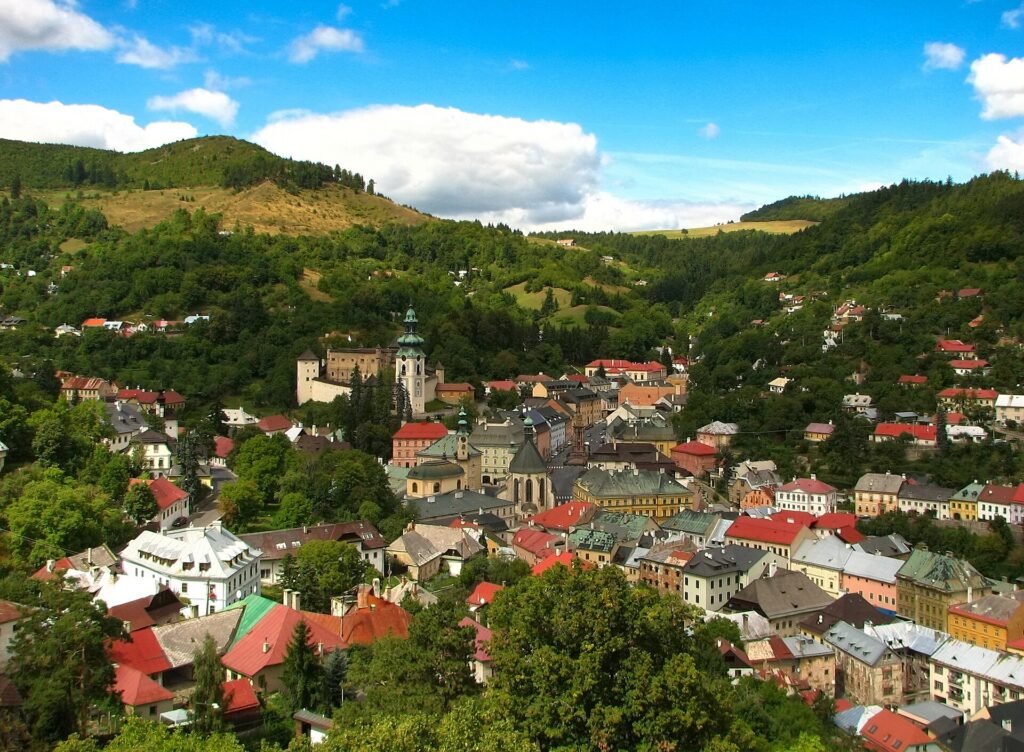
- 1993 UNESCO World Heritage listing
- 24 mining reservoirs left of about 60
- Under 2 hrs by car from Bratislava
- 46 to 50 °F inside the show mine
Banská Štiavnica is a former silver and gold mining town in central Slovakia, set among the forests of the Štiavnica Mountains. The last mine closed in 2001, according to the national tourist board. UNESCO listed the town and the mining works around it in 1993, describing it as an outstanding example of a mining settlement that has grown since the Middle Ages.
Most of what a visitor needs (mine tour slots, castle hours, parking rules) is published only in Slovak. We read those pages on October 13, 2026, compared them with English-language official sources, and flag below where they disagree or stay silent.
Advised Traveler is free to use. If you find our content useful, you can support us by booking through our affiliate links: we earn a commission at no extra cost to you.
- Things to do
- Mine tours and castles: days and prices
- One-day itinerary
- The Calvary
- Mining lakes (tajchy)
- Driving from Bratislava and parking
- Where to stay
- Entry rules, safety and health
- FAQ
- Sources
Things to do in Banská Štiavnica
The short answer: go underground in a real mine, walk between two castles, climb the Baroque Calvary and end the day at one of the old mining reservoirs. The historic core is compact and walkable; the Calvary and the lakes sit on its edge.
- Holy Trinity Square (Námestie sv. Trojice): the main square, with the Holy Trinity column at its center. It is a residents-only parking zone, so arrive on foot.
- Mining Academy: UNESCO credits the town with the first Mining and Forestry Academy in Europe, founded in 1762. Slovakia’s national tourist board traces it to a mining school opened in 1735.
- Kammerhof: a Slovak Mining Museum exhibition covering mining from the oldest archaeological finds to the 20th century, including mine maps and how water was pumped out.
- Old Castle and New Castle: the Old Castle is at Starozámocká 11; the New Castle is a Renaissance fortress built from 1564 to 1571 at Novozámocká 22.
Still closed after the 2023 fire: a fire on March 18, 2023 burned seven buildings on the main square. The Bank of Love (Banka lásky), a popular stop, says on its website that it will stay closed longer than planned and only mentions “2026”, with no date, as of October 13, 2026.
Mine tours and castles: opening days and prices
The Slovak Mining Museum (Slovenské banské múzeum) runs the ticketed sites. None of its pages lists Monday opening, and prices are shown as “from” amounts in euros.
| Site | Open | From |
|---|---|---|
| Open-air mine | Wed to Fri: entries at 10 am, noon, 2 pm, 4 pm. Sat and Sun: hourly, 9 am to 4 pm | €14 |
| Old Castle | Wed to Sun, 9 am to 5 pm | €8 |
| New Castle | Tue to Sat, 9 am to 5 pm | €5 |
| Kammerhof | Tue to Sat, 9 am to 5 pm | €8 |
| Glanzenberg adit | Fri 1 pm; Sat 11 am and 1 pm, booking required | €9 |
- Open-air Mining Museum (Banské múzeum v prírode): about 1 km (0.6 mile) from the center. The tour lasts 90 to 100 minutes, with 130 steps down into the mine and the same climb back. Underground it stays at 46 to 50 °F, so bring a warm layer.
- Glanzenberg adit: an old mining adit beneath the town. The open section is about 500 m (1,640 ft) long and ends at the Kaufhaus shaft, 32 m (105 ft) down. Tours take about 90 minutes and start at the ticket office in the white building next to the post office, Kammerhofská 26.
Touring in English: standard tours are in Slovak. The museum charges €20 extra for an English-language tour at the open-air mine, the Old Castle, the New Castle and the Kammerhof, and asks for at least 24 hours’ notice at the mine. The Old Castle’s outdoor areas can be seen on your own.
Day tours from Bratislava
Without a car, a guided day trip is the simplest option. Below are the tours offered by our partner GetYourGuide; check whether the mine or castle tickets are included and in which language the guide works, since on-site tours default to Slovak. One listing on October 13, 2026 was a Banská Štiavnica guided walk that includes museum entry.
See all Banská Štiavnica tours and activities on GetYourGuide
A one-day itinerary that fits the opening days
One full day covers the essentials if you come between Wednesday and Saturday, the only days when the mine, both castles and the Kammerhof are all open. No museum site lists Monday hours, which leaves the Calvary grounds and the lakes.
- Morning: the open-air mine at the 10 am entry (weekdays) or any hour from 9 am (weekends). Book the English tour a day ahead.
- Late morning: walk down to Holy Trinity Square and the Kammerhof.
- Early afternoon: the Old Castle, then the New Castle, both open until 5 pm.
- Late afternoon: the 20-minute walk up to the Calvary, open all year.
- Second day, if you have one: the Glanzenberg adit on a Friday or Saturday, a swim at a tajch in summer, or the spa at Sklené Teplice.
The Baroque Calvary, 20 minutes above town
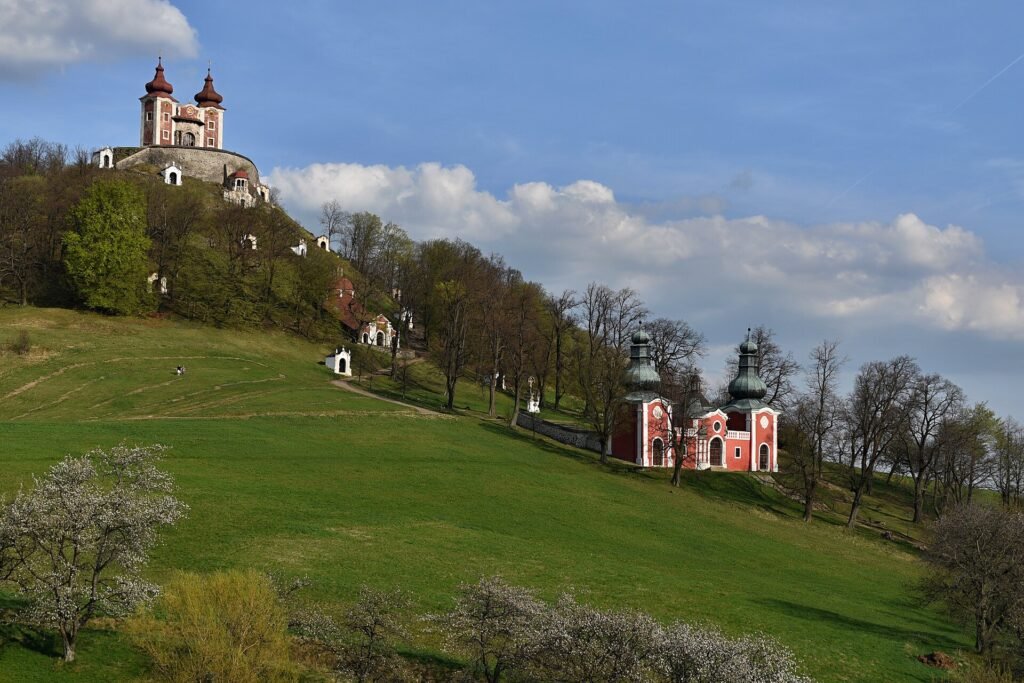
The Calvary (Kalvária) is a Baroque pilgrimage complex of churches and chapels climbing a hill above town. The national tourist board counts 23 sacred monuments. The grounds are free and open year-round, about a 20-minute walk from the center; the nearest bus stop is Pod Kalváriou.
Inside access is limited. The lower church usually opens in season when the weather is good. The middle and upper churches stay locked, but you can look in through a grille. The visitor center is generally open daily from June to September and mostly on weekends the rest of the year.
The tajchy: mining reservoirs you can swim in
Tajchy are artificial lakes built to supply the mines with water. The regional tourist office says there were 60 and that 24 survive, now used for swimming and recreation; the national tourist board says about a third remain. UNESCO dates the system to the 16th century, expanded in the 18th.
The largest, Počúvadlo (Počúvadlianske jazero), covers 11.73 hectares, about 29 acres. Other names you will see on local maps include Klinger, Vindšachta and Veľký Studenský tajch. We did not find an official source for water quality or lifeguard hours, so check locally before swimming.
Driving from Bratislava, and where to park
The regional tourist office puts the drive from Bratislava at under two hours. The R1 expressway passes about 20 km (12 miles) from town, and several exits lead up into the hills.
- Pick your exit: the first turnoff, at Žarnovica toward Hodruša-Hámre, is steep, winding and often in poor repair. The office recommends the Hronská Breznica exit in winter and fog: no big climbs and the best maintenance, for roughly 30 km (19 miles) of extra driving.
- Vignette: Slovak motorways require an electronic vignette. For a car it costs €8.10 for one day, €10.80 for 10 days or €17.10 for 30 days, bought online at eznamka.sk.
- U.S. license and rules: the State Department says a U.S. license is valid for up to 90 days, the blood alcohol limit is zero, and every car must carry a reflective vest and a first-aid kit. Winter tires are required in snowy conditions.
Parking lots and rates
Outside marked spaces, the whole historic core is a no-stopping zone, and short-stay spaces carry a 30-minute limit. Leave the car in one of the lots below.
| Lot | Rate | Note |
|---|---|---|
| Dolná (P3), Mládežnícka (P2) | €2 per hour | First hour free |
| Akademická | €2 per hour | Park-and-walk |
| Novozámocká (P1), J. K. Hella, Pod Kalváriou | €4 for 2 hours | €8 all day |
Payment is by text message, which works only with a Slovak mobile carrier, or through the ParkDots app, the practical option with a U.S. phone.
By bus or train
A direct bus runs from Bratislava, according to the tourist office, which does not publish its timetable. By rail, you change at Hronská Dúbrava for a small regional train. The station on Trate mládeže is just under 3 km (1.9 miles) from the center: about 35 minutes on foot, or a taxi for €2 to €4.
Where to stay in Banská Štiavnica
Your car decides most of it. Sleeping in the old town puts every sight within walking distance but makes parking a question to settle before you book; the lake area and the spa villages suit drivers. We give no nightly rates because we found no reliable published source.
Old town hotels on Kammerhofská and Andreja Kmeťa streets
Hotel Grand Matej stands at Kammerhofská 5, the main street that leads to the Kammerhof and the Glanzenberg ticket office. Hotel Bristol is at Andreja Kmeťa 11; its Trip.com listing mentions private parking for a daily fee, not bookable in advance.
Lake Počúvadlo: for drivers and summer swimmers
Guesthouses around the largest tajch put you on the water rather than on the cobblestones. You will need a car to get back and forth to the old town.
Sklené Teplice: a thermal spa 7.5 miles away
Sklené Teplice lies 12 km (7.5 miles) from Banská Štiavnica, according to the national tourist board, and has been used as a spa since the 16th century. Its springs run from 100 to 126 °F, and its best-known feature is the Parenica cave bath, fed by water at about 108 °F.
Before you book: ask the property where you can leave the car and whether parking is included, since the old town has few spaces and Holy Trinity Square is for residents only. The map shows what is available for your dates.
See current prices and reviews for Banská Štiavnica stays
Weather and seasons
We found no published table of monthly climate normals for Banská Štiavnica that we could read and cite, so this guide gives no monthly temperatures. What the sources do document: the Calvary visitor center keeps daily hours from June to September, and the State Department notes that Slovak law requires winter tires in snowy conditions, which matters on the hill roads into town.
Entry rules, safety and health for U.S. travelers
Slovakia is at Level 1, “Exercise normal precautions”, in the State Department advisory issued February 12, 2026, which calls it generally safe. It is in the Schengen area and uses the euro.
- Passport: valid at least 3 months beyond your departure date, with one blank page. No visa for stays of 90 days or less.
- Entry/Exit System: U.S. travelers are registered in the EU’s EES at the Schengen border.
- ID on you: anyone over 16 must carry a passport at all times; a photocopy is not accepted.
- Emergencies: 112 for ambulance and general emergencies, 158 for police. The U.S. Embassy is at Hviezdoslavovo námestie 4 in Bratislava; after-hours emergencies: +421-2-5922-3000.
- Ticks: the State Department lists the tick-borne encephalitis vaccine as recommended. Ask your doctor if you plan to hike in the Štiavnica Mountains.
- Water: tap water is safe to drink.
Medical care is not free for visitors: without Slovak insurance, an ambulance starts at €120 per trip, and Medicare and Medicaid do not pay abroad. The State Department strongly recommends supplemental coverage that includes medical evacuation.
One option is SafetyWing Nomad Insurance Essential, from our partner. On October 13, 2026, its page listed up to $250,000 for medical treatment and $100,000 lifetime for medical evacuation, billed every four weeks; pre-existing conditions, maternity and cancer treatment are excluded, and U.S. coverage is an extra. First-time customers can enter the code ADVISEDTRAVELER (pink camera icon on the Nomad Insurance page, before creating an account) for 8 weeks of the Electronics Theft add-on on 28-day subscription or annual Essential plans; after 8 weeks it renews as a paid add-on.
Readers living in Europe can also look at Chapka Cap Assistance, which is not open to U.S. residents.
For data, a U.S. carrier’s international plan may already include Slovakia; compare its daily rate with an eSIM from our partner Yesim, and confirm on its site that a Slovakia plan is listed before buying.
Banská Štiavnica FAQ
What are the top things to do in Banská Štiavnica?
Tour the open-air mine, visit the Old and New Castles and the Kammerhof, walk up to the Baroque Calvary and, in summer, swim in a tajch such as Počúvadlo.
Can you do Banská Štiavnica in one day?
Yes, if you come between Wednesday and Saturday, when the mine, both castles and the Kammerhof are all open. The drive from Bratislava takes under two hours each way.
Can you tour the mine in English?
Yes, for a €20 surcharge on top of the ticket, booked at least 24 hours ahead. Standard tours are in Slovak.
Is Banská Štiavnica open on Mondays?
The Mining Museum’s sites list no Monday hours. The Calvary grounds are open every day of the year.
Where do you park in Banská Štiavnica?
In the Dolná and Mládežnícka lots, where the first hour is free and then €2 an hour, or at Novozámocká for €8 a day. Pay with the ParkDots app if your phone is not on a Slovak network.
Why is Banská Štiavnica a UNESCO site?
UNESCO lists the town and the technical monuments around it, 20,632 hectares in all, as an outstanding example of a mining settlement developed since the Middle Ages, with its reservoir system and Europe’s first mining academy.
Sources
All pages below were opened on October 13, 2026. Slovak-language pages were read in the original.
- UNESCO, Historic Town of Banská Štiavnica and the Technical Monuments in its Vicinity.
- U.S. Department of State, Slovakia international travel information (advisory of February 12, 2026).
- Slovak Mining Museum (in Slovak): open-air mine, Old Castle, New Castle, Kammerhof, Glanzenberg adit.
- Banská Štiavnica regional tourist office (in Slovak): getting there, parking, tajchy.
- Banská Štiavnica Calvary, visitor information (in Slovak).
- Slovakia Travel, national tourist board: Banská Štiavnica, Štiavnica tajchy, Sklené Teplice spa.
- eznamka.sk, vignette types and prices (in Slovak).
- Banka lásky (in Slovak), Trip.com listing for Hotel Bristol, Slovak Academy of Sciences conference page for Hotel Grand Matej’s address.
- SafetyWing, Nomad Insurance.
Planning more of Slovakia? See our Slovakia travel guide and the city guides for Bratislava and Bojnice.
Compiled by the Advised Traveler team from the sources listed above. Mine slots and museum days are the details most likely to shift between seasons, so check the museum’s site the week you go. Found something out of date? Tell us.