
Slovakia Travel Guide: Bratislava, Spiš Castle, the Tatras and the Rules of the Road
What a U.S. passport holder needs, where to go beyond the capital, how the e-vignette works, bears and mountain rescue, and the weather month by month.
- Level 1 State Department advisory
- 90 days visa-free in the Schengen Area
- 0.0 legal blood alcohol limit for drivers
- 8 UNESCO World Heritage sites
Is Bratislava worth visiting? It is the obvious first stop, but most of what puts Slovakia on the UNESCO list lies further east: a silver-mining town in the hills, one of Central Europe’s largest castle complexes and a string of wooden churches near the Polish and Ukrainian borders. Slovakia uses the euro and sits inside the Schengen Area, so it combines easily with Vienna, Budapest or Prague.
This guide draws on the State Department’s Slovakia page (updated February 12, 2026), the official e-vignette portal, the Slovak tourism board and UNESCO. It links to our five Slovak city and site guides.
Advised Traveler is free to use. If you find our content useful, you can support us by booking through our affiliate links: we earn a commission at no extra cost to you.
- Passport and entry
- Where to go
- Best time to visit
- Driving and the e-vignette
- Hiking, bears and rescue
- Health, insurance and phone
- Where to stay
- FAQ
- Sources
Do Americans need a visa for Slovakia?
No. U.S. citizens can stay up to 90 days without a visa, as in the rest of the Schengen Area. Your passport must be valid for at least three months beyond the date you plan to leave, with one blank page per entry stamp. Registration in the EU’s Entry/Exit System (EES) now applies at Schengen borders, Slovakia included.
- Staying longer than 90 days: you need a visa or residence permit and local health insurance.
- Safety: the State Department rates Slovakia Level 1, “Exercise normal precautions” (issued February 12, 2026).
- U.S. Embassy: Hviezdoslavovo námestie 4, Bratislava; after-hours emergencies +421-2-5922-3000.
Where to go in Slovakia beyond Bratislava
UNESCO lists eight Slovak properties. Three are shared with neighbors: the caves of the Aggtelek and Slovak Karst, the primeval beech forests of the Carpathians and the Danube section of the Roman frontier. The other five are towns and monuments, and they shape most itineraries.
Bratislava
The capital sits on the Danube, and many visitors arrive through Vienna. The U.S. Embassy faces Hviezdoslav Square in the old town. Neighborhoods, sights and getting around are covered in our Bratislava guide.
- Keep in mind: drinking alcohol in the street is banned in most Slovak towns.
- Getting around: validate your bus or tram ticket as soon as you board.
Banská Štiavnica
Listed in 1993 together with the technical monuments around it, this hill town is described by the Slovak tourism board as a protected reserve that tells the story of the country’s mining tradition. Our updated guide covers it in detail: Banská Štiavnica.
- Best for: two or three slow days of museums and hill walks.
- Pair it with: Vlkolínec, a village reserve of folk architecture listed the same year.
Spiš Castle and Levoča
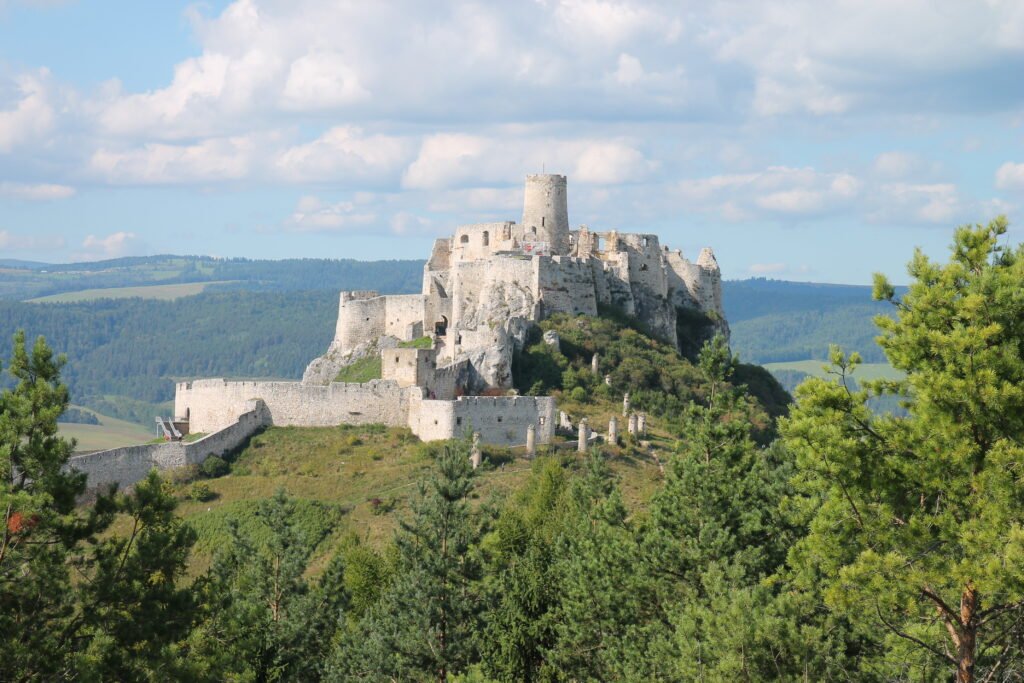
Spiš Castle and its surroundings joined the World Heritage List in 1993, and the town of Levoča was added to the same property in 2009. Slovakia’s tourism board calls the castle the largest medieval castle compound in Central Europe. See our Spiš guide.
- What’s included: Spišské Podhradie, Spišská Kapitula and the 14th-century Church of the Holy Spirit in Žehra.
- Nature nearby: the travertine of the Dreveník nature reserve, part of the same ensemble.
Bardejov and the wooden churches
Listed in 2000, Bardejov is billed by the tourism board as the most Gothic town in Slovakia. Eight wooden churches of the Carpathians followed in 2008: Catholic churches in Hervartov and Tvrdošín, Lutheran “articular” churches in Kežmarok, Leštiny and Hronsek, and Eastern-rite churches in Bodružal, Ladomirová and Ruská Bystrá.
- Best for: a road trip, since the churches stand in separate villages.
- Getting there: plan on a rental car and a valid e-vignette for any motorway stretch.
We also have guides to Košice and Bojnice.
Walking tours of Bratislava, castle day trips and guided hikes are listed by our partner GetYourGuide under the button below. For anything in the mountains, check whether rescue is covered before you book: the State Department warns that standard travel insurance often leaves it out.
See all Slovakia tours and activities on GetYourGuide
When is the best time to visit Slovakia?
May, June and September are the most comfortable months for towns and castles, with average highs of 71 to 78°F in Bratislava. July and August are the warmest (82°F) and also the wettest, at about 2.4 inches a month. From December through February, highs stay below 43°F and nights drop below freezing.
- Jan 27 / 38 °F
- Feb 29 / 42 °F
- Mar 35 / 52 °F
- Apr 42 / 64 °F
- May 51 / 71 °F
- Jun 58 / 78 °F
- Jul 61 / 82 °F
- Aug 61 / 82 °F
- Sep 52 / 71 °F
- Oct 43 / 60 °F
- Nov 37 / 49 °F
- Dec 29 / 39 °F
Bratislava airport: average low and high by month, 1991-2020 normals. Dark blue: high below 50 °F. Light blue: 50 to 67 °F. Yellow: 68 to 81 °F. Orange: 82 °F and above.
| Month | Low / high | Rain |
|---|---|---|
| January | 27 / 38 °F | 1.5 in |
| April | 42 / 64 °F | 1.4 in |
| July | 61 / 82 °F | 2.4 in |
| October | 43 / 60 °F | 1.7 in |
| Year | 44 / 61 °F | 22.6 in |
About these numbers: they are the 1991-2020 WMO climate normals for the Bratislava airport station published by NOAA NCEI, as reproduced in Wikipedia’s “Geography of Bratislava” article. Treat them as a rough guide. The mountains in the center and north run much colder.
Winter trips work if you plan for the roads: winter tires are mandatory, and chains are required in some mountain areas.
Driving in Slovakia: e-vignette, headlights and zero alcohol
A U.S. driver’s license is valid in Slovakia for up to 90 days. Motorways and expressways require an electronic vignette tied to your license plate, sold on the official eznamka.sk portal and its app. Ask your rental company whether the car already has one.
| Car vignette | Valid | Price |
|---|---|---|
| 1 day | until midnight | €8.10 |
| 10 days | from the day chosen | €10.80 |
| 30 days | from the day chosen | €17.10 |
| 365 days | from the day chosen | €90 |
- Alcohol: the legal limit is zero.
- Speed limits: 130 km/h (about 80 mph) on motorways, 90 km/h (56 mph) on other roads, 50 km/h (31 mph) in towns.
- Headlights: low beams on at all times, day and night.
- Winter: winter tires are mandatory; chains in some mountain areas.
Hiking in the Tatras: bears, marked trails and rescue costs
Slovakia has around 1,200 brown bears, mostly in the Low and High Tatras and the Lesser and Greater Fatra ranges, according to the French foreign ministry, which reports attacks even in inhabited areas and advises staying on marked trails.
Before a mountain hike: the State Department notes that mountain rescue may not be covered by standard travel insurance and can be costly without a dedicated mountain policy.
Health, travel insurance and staying connected
Medical care is not free for visitors: the State Department says an ambulance starts at 120 euros without Slovak insurance and strongly recommends evacuation coverage. It also recommends the tick-borne encephalitis vaccine, and tap water is safe to drink.
Our partner SafetyWing sells Nomad Insurance, a travel medical plan open to U.S. travelers; read the policy terms on mountain sports and rescue before a Tatras trip. Readers living in Europe can also look at Chapka Cap Assistance.
Slovakia has 3G and 4G coverage. If your U.S. plan charges a daily international fee, a Slovakia eSIM from our partner Yesim is an alternative; check first that your phone is unlocked and eSIM-compatible. Emergency number: 112.
Where to stay in Slovakia
For a short trip, base yourself in Bratislava. For a loop through the country, add a night or two in Banská Štiavnica, then Levoča or Košice for Spiš Castle. The map opens on Bratislava; type another town in its search box to move it.
Compare Bratislava hotels: recent prices and reviews
Slovakia travel FAQ
Is Slovakia safe for American tourists?
The State Department rates it Level 1, “Exercise normal precautions,” the lowest level, as of February 12, 2026.
How long can a U.S. citizen stay in Slovakia?
Up to 90 days without a visa, with a passport valid three months past your departure date.
What currency does Slovakia use?
The euro.
Do I need a vignette to drive in Slovakia?
Yes, on motorways and expressways. A 10-day car vignette costs €10.80 on eznamka.sk.
What is the best time to visit Bratislava?
Late spring and September, when average highs sit between the low 70s and high 70s °F; July and August are hotter and a little wetter.
Sources
Checked on November 6, 2026.
- U.S. Department of State, Slovakia International Travel Information (last updated February 12, 2026).
- Národná diaľničná spoločnosť (Slovak national motorway company), Types of electronic vignettes.
- UNESCO World Heritage Centre, properties in Slovakia.
- Slovakia.travel, official tourism portal, UNESCO Cultural Heritage.
- French Ministry for Europe and Foreign Affairs, travel advice for Slovakia (updated September 15, 2026, in French).
- Wikipedia, Geography of Bratislava, climate table of 1991-2020 normals for the Bratislava airport station, credited to NOAA (WMO climate normals).
Written by the Advised Traveler team from the sources listed, without an on-site visit. Vignette prices change, so confirm them on eznamka.sk when you buy. Spot an error? Let us know.