
Spain Travel Guide: Entry Rules for Americans, Where to Go, Weather by Month, and Getting Around
Passport validity and the new EU border system, seven regions with our city guides, Madrid temperatures month by month, high-speed trains, and Spanish road rules.
- 90 days visa-free in any 180 (Schengen)
- 3 months of passport validity past departure
- 50 UNESCO World Heritage sites
- 75 mph top speed on highways
Spain covers about 195,000 square miles across the Iberian Peninsula, the Balearic Islands, and the Canary Islands, where Mount Teide rises to 12,188 feet. Close to 50 million people live here, and Madrid is both the capital and the largest city.
We built this page as the starting point for our Spanish city guides, grouped by region, plus the paperwork and planning questions to settle before you fly. Entry rules come from Spain’s Ministry of Foreign Affairs and the European Commission, health advice from the CDC, climate normals from Spain’s weather agency, AEMET, and country figures from INE, the national statistics institute. Everything was checked between October 16 and October 20, 2026.
Advised Traveler is free to use. If you find our content useful, you can support us by booking through our affiliate links: we earn a commission at no extra cost to you.
- Visa and passport rules
- EES and ETIAS
- Where to go
- How many days
- Best time to visit
- Trains and driving
- Is Spain safe?
- Where to stay
- Health, money, data
- FAQ
- Sources
Do Americans need a visa for Spain?
No. U.S. citizens can visit Spain without a visa for up to 90 days within any 180-day period, and that clock covers the whole Schengen Area, not Spain alone. Days spent in France, Italy, or Portugal on the same trip count toward the same 90.
Spain’s Ministry of Foreign Affairs lists what border officers can check under the Schengen Borders Code:
- Passport: valid for at least three months after the date you plan to leave the Schengen Area, and issued within the previous ten years.
- Onward travel: a return or onward ticket.
- Lodging: a hotel booking, a tour reservation, or a letter of invitation from a host.
- Funds: proof you can cover your stay; the ministry’s 2024 figure is €113.40 per person per day, with a minimum of €1,020.60 whatever the length of the trip.
Check the issue date, not just the expiration date: a passport issued more than ten years before your arrival does not meet the rule, even if it hasn’t expired yet.
The EU Entry/Exit System is live; ETIAS is not yet
Since April 10, 2026, the European Union’s Entry/Exit System (EES) has replaced passport stamps at Schengen borders. On your first crossing, it records your passport details, fingerprints, and a facial image, then logs each entry and exit so overstays are flagged automatically.
ETIAS, the travel authorization that visa-exempt visitors such as Americans will eventually need before departure, is not running yet: the European Commission says no applications are being collected and the start date will be announced several months ahead. Its fee has been set at €20. Be wary of websites already charging for an “ETIAS” application.
Where to go in Spain: seven regions and our city guides
We have a page for every city linked below. Those marked “updated guide” have already been rewritten with dated sources; the rest are next in line.
Madrid and the Castilian cities
The capital sits at the hub of the rail network, with historic cities in reach: Madrid, Toledo, Segovia, Ávila, Salamanca, Cuenca, Burgos, and Cáceres in Extremadura. Driving into central Madrid is restricted, so leave the rental car outside the center.
Andalusia
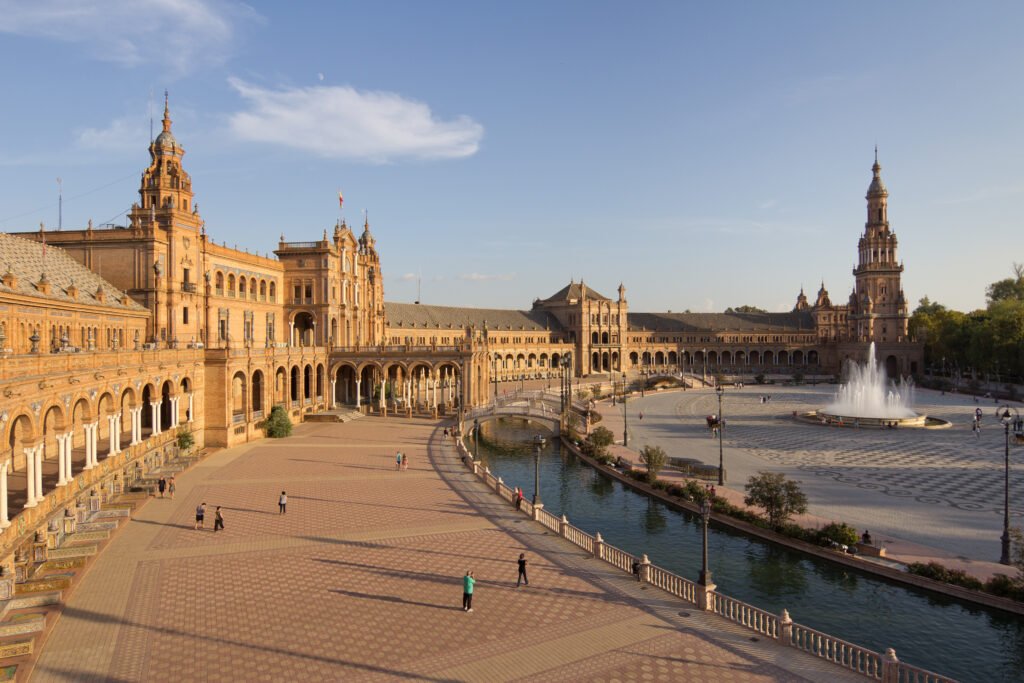
Seville, Granada, Córdoba, Málaga, Cádiz, Ronda, Marbella, Huelva, and Almería. Seville averages a 97 °F high in July, so plan outdoor sightseeing for mornings in summer.
Barcelona, Catalonia, and the Valencia coast
Barcelona, Girona, Tarragona, Valencia, Alicante, Castellón, and Murcia. Ferries and fast boats leave Barcelona for Mallorca, Menorca, Ibiza, and Formentera, an easy way to add an island.
Basque Country, Navarre, La Rioja, and Aragon
San Sebastián, Bilbao, Vitoria-Gasteiz, Pamplona, Logroño, and Zaragoza. Bilbao’s central Abando and Indautxu districts are a low-emission zone that foreign-registered cars must register for in advance.
Cantabria, Asturias, and Galicia
Santander (updated guide), Gijón, Oviedo, Santiago de Compostela, A Coruña (updated guide), Vigo, Pontevedra, Lugo, and Ourense. This is the end point of the Camino de Santiago; France’s foreign ministry advises walkers to book their beds ahead.
The Balearic Islands
Mallorca and its capital, Palma; Menorca and Mahón; and Ibiza. Drownings are not rare on these beaches, so swim where lifeguards are posted.
The Canary Islands
Tenerife and Santa Cruz de Tenerife, Gran Canaria and Las Palmas, Lanzarote and Arrecife, Puerto del Rosario on Fuerteventura, San Sebastián de la Gomera, Santa Cruz de la Palma, and Valverde on El Hierro. The islands run one hour behind mainland Spain.
For skip-the-line entries, walking tours, and day trips, the button below opens our partner GetYourGuide’s listings for Spain. Before booking a day trip, check the departure city and return time, especially if you have a train to catch that evening.
See Spain tours and activities on GetYourGuide
How many days do you need in Spain?
More than most first-timers expect. Rather than racing across the country, pick one or two regions and connect them by high-speed train through Madrid. A few combinations that work:
- 7 to 10 days: Madrid plus Andalusia (Seville, Córdoba, Granada), or Barcelona and the coast down to Valencia.
- Two weeks: Madrid with Toledo or Segovia, then Andalusia; or the north, from San Sebastián and Bilbao to Santander and Galicia.
- Three weeks: a Barcelona, Valencia, Andalusia, Madrid loop, or a mainland route plus a week on one island.
- Adding Portugal: Galicia and Andalusia both border it, and the 90-day Schengen limit covers both countries together.
About travel times: we don’t list train or driving times here because we haven’t verified each route against an official timetable. Check them with the rail operator when you book.
Best time to visit Spain: temperatures by month
Madrid gets little rain in any season, about 16.6 inches a year and roughly half an inch or less in July and August, so heat is what shapes the calendar. June through August average highs of 83 °F or more, peaking at 90 °F in July. From November to March, afternoons stay at or below the low 60s. May and September, with highs of 72 to 80 °F, are the most comfortable months for city walking, and October, around 67 °F, comes close.
- Jan 37 / 50 °F
- Feb 39 / 54 °F
- Mar 43 / 61 °F
- Apr 46 / 65 °F
- May 52 / 72 °F
- Jun 61 / 83 °F
- Jul 66 / 90 °F
- Aug 66 / 88 °F
- Sep 60 / 80 °F
- Oct 51 / 67 °F
- Nov 43 / 56 °F
- Dec 38 / 50 °F
Average monthly low and high in Madrid (Retiro Park), 1981-2010 AEMET normals. Dark blue: high under 50 °F. Light blue: 50 to 67 °F. Yellow: 68 to 81 °F. Orange: 82 °F and above.
| Month | Low / high | Rain (days) |
|---|---|---|
| Jan | 37 / 50 °F | 1.3 in (6) |
| Feb | 39 / 54 °F | 1.3 in (5) |
| Mar | 43 / 61 °F | 1.0 in (4) |
| Apr | 46 / 65 °F | 1.8 in (7) |
| May | 52 / 72 °F | 2.0 in (7) |
| Jun | 61 / 83 °F | 0.8 in (3) |
| Jul | 66 / 90 °F | 0.5 in (2) |
| Aug | 66 / 88 °F | 0.4 in (2) |
| Sep | 60 / 80 °F | 0.9 in (3) |
| Oct | 51 / 67 °F | 2.4 in (7) |
| Nov | 43 / 56 °F | 2.3 in (7) |
| Dec | 38 / 50 °F | 2.0 in (7) |
| Year | 16.6 in |
Other cities run differently: Seville Airport averages a 97 °F high in July, while Barcelona Airport tops out at 83 °F in August and gets its heaviest rain in October, about 3.6 inches, followed by September at 3.2 inches. All figures are AEMET 1981-2010 normals; rain days count days with at least 0.04 inch.
Fall can also bring sudden heavy rain and flash flooding. AEMET, Spain’s weather agency, publishes the official warnings.
Getting around Spain: high-speed trains or a rental car
Spain’s rail network links every regional capital with Madrid, with a growing number of high-speed AVE lines, and stations usually sit close to the city center. Two things surprise visitors: AVE stations screen luggage much like an airport, and you’ll be asked for your passport number when buying a ticket.
If you rent a car: speed limits are 120 km/h (75 mph) on highways, 100 km/h (62 mph) on national roads, and 50 km/h (31 mph) in towns, and non-residents pay fines on the spot in cash. The blood alcohol limit is 0.05 percent, or 0.03 percent for drivers licensed under two years. A reflective vest kept inside the cabin and two warning triangles are mandatory. “Autovías” are toll-free; “autopistas” charge tolls.
These road rules come from France’s foreign ministry travel advice for Spain, which also flags restricted traffic zones in central Madrid, Barcelona, and Bilbao for foreign-registered vehicles.
Is Spain safe for tourists?
France’s foreign ministry keeps all of Spain at its normal-vigilance level, and the most common problem it describes for visitors is theft. It reports frequent pickpocketing in tourist areas and big cities, sometimes with violence in Barcelona and the Balearics, and singles out Seville’s Plaza de España and María Luisa Park. Spain’s Interior Ministry rates the terrorism threat at 4 on a 5-point scale, so stay alert on public transportation and at crowded sights.
- Roadside scams: be wary of strangers offering help with a flat tire, a known trick on the AP-7 between the French border and Barcelona.
- Reporting a crime: Spain’s AlertCops app connects you with police in your own language.
- Lost passport: once reported lost or stolen, it can’t be used again even if found, so carry a copy and leave the original locked up.
Where to stay in Spain
Each regional card above links to hotels, and our city guides break down neighborhoods. Spanish law requires hotels and vacation rentals to record every guest’s ID details, so have your passport ready at check-in. The map opens on Barcelona; type another city into its search box to move it.
See current prices and reviews for hotels across Spain
Health, travel insurance, money, and phone data
The CDC asks all travelers to Spain to be up to date on routine vaccines, including measles (MMR), as measles cases rise worldwide, and suggests hepatitis A for most travelers. France’s foreign ministry notes that private clinics and doctors in Spain charge very high rates.
Our partner SafetyWing Nomad Insurance Essential is open to U.S. residents; read its plan page for limits and eligibility before you buy. New SafetyWing customers who enter code ADVISEDTRAVELER get the Electronics Theft add-on free for 8 weeks on 28-day subscription or annual Nomad Essential plans. Enter it after tapping the pink camera icon on the Nomad Insurance page, before you set up your account; after 8 weeks the add-on renews at its regular price. Readers living in Europe can look at Chapka’s Cap Assistance 24/7, which isn’t available to U.S. residents.
Cards and data: cards and phone payments are accepted almost everywhere, and Spain uses the euro. EU roaming rules don’t cover U.S. plans, so compare your carrier’s international pass with a Spain eSIM from our partner Yesim, installed before you leave.
Spain travel FAQ
Do U.S. citizens need a visa to visit Spain?
No, not for tourist stays of up to 90 days in any 180-day period across the Schengen Area.
How long must my passport be valid for Spain?
At least three months beyond your planned departure from the Schengen Area, and issued within the last ten years.
Do I need ETIAS to travel to Spain?
Not yet. ETIAS isn’t operating, and the EU says it will announce the start date months in advance. The Entry/Exit System, which takes fingerprints and a photo at the border, has been in force since April 10, 2026.
What is the best month to visit Spain?
For city sightseeing, May or September, with Madrid highs between 72 and 80 °F; October is a little cooler, around 67 °F. In July and August, Madrid averages highs near 90 °F.
Can I drive in Spain with a U.S. license?
Rules for foreign licenses vary by country and length of stay, and we haven’t confirmed them against an official Spanish source. Ask your rental company before you travel.
Is it better to take the train or drive in Spain?
For trips between major cities, the high-speed train through Madrid avoids parking and low-emission zones. A car makes more sense for villages and coastlines away from the rail lines.
Sources
Pages checked on October 16, 2026; AEMET, INE, MITECO, Spanish consulate, Spanish Foreign Ministry, and Spanish Navy sources checked on October 20, 2026.
- Spain’s Ministry of Foreign Affairs, Conditions for entry into Spain (passport, funds, lodging).
- European Commission, Entry/Exit System and ETIAS.
- Consular Section of the Embassy of Spain in Washington, D.C., Conditions for entry into Spain (visa exemption for U.S. citizens).
- CDC, Spain traveler view.
- France Diplomatie (French Ministry for Europe and Foreign Affairs), Spain: safety and useful information (updated October 13, 2026; in French).
- AEMET, Spain’s State Meteorological Agency, 1981-2010 standard climate values: Madrid, Retiro, Seville Airport, and Barcelona Airport.
- INE, Spain’s National Statistics Institute: population on July 1, 2026 and España en cifras 2026 (land area; in Spanish).
- Spain’s Ministry for the Ecological Transition (MITECO), Teide National Park.
- Spain’s Ministry of Foreign Affairs, Permanent Delegation to UNESCO, World Heritage (50 listed properties; in Spanish).
- Spanish Navy, Revista General de Marina, May 2015 (legal time in the Canary Islands; in Spanish).
Maintained by the Advised Traveler Team. Schengen entry rules are changing as the EU rolls out its new systems, so recheck them before you book. Spot an error? Let us know.