
Salvador, Brazil: Things to Do, Getting Around and Safety
The State Department advisory and e-visa rules, the airport metro, Pelourinho’s churches, Barra’s forts and the bay islands, compiled from official Brazilian and US sources.
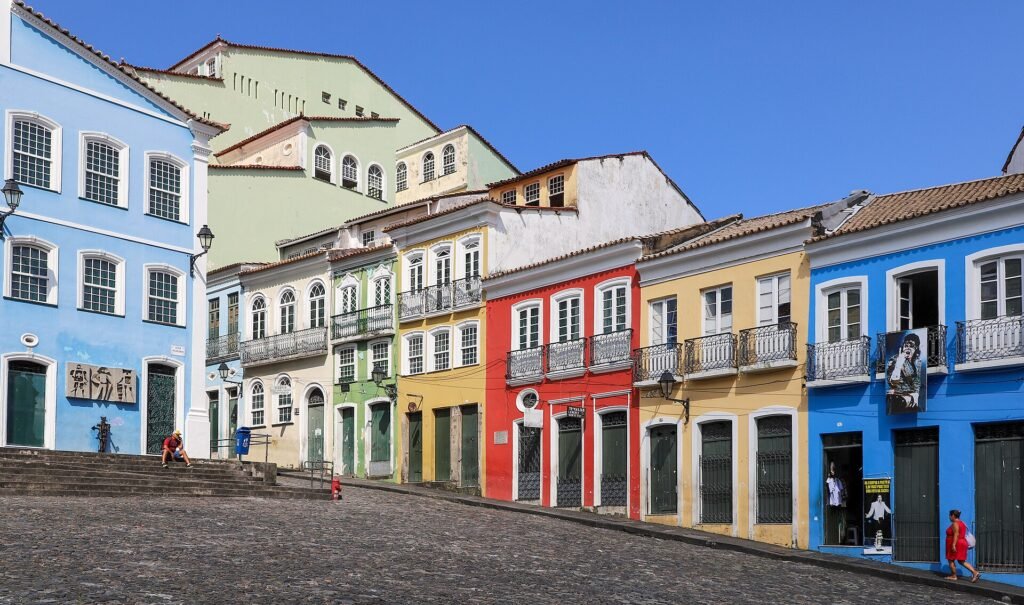
- 1549 founded as Brazil’s first capital
- Level 2 State Department advisory for Brazil
- R$4.10 metro ride from the airport
- April to July the four wettest months
Salvador, the capital of the state of Bahia, was Brazil’s first capital, from 1549 to 1763. Its historic center around Pelourinho has been a UNESCO World Heritage site since 1985, and the city had 2,417,678 residents in the 2022 census.
This guide compiles what the City of Salvador, the State of Bahia, transit operators, the US State Department and the CDC publish, as consulted on October 11, 2026. It also flags what is closed: the São Francisco church, for one, has not been open to visitors since February 2025.
Advised Traveler is free to use. If you find our content useful, you can support us by booking through our affiliate links: we earn a commission at no extra cost to you.
Salvador in six facts
- Location: capital of Bahia, in Brazil’s Northeast, on the Bay of All Saints (Baía de Todos-os-Santos).
- Layout: an upper city (Cidade Alta) and a lower city (Cidade Baixa), 279 ft (85 m) apart in elevation.
- Airport: Salvador Bahia Airport (SSA), 17 miles (28 km) from downtown according to its operator, and linked to the metro.
- Entry for US citizens: a visa is required, and Brazil issues an e-visa online.
- Electricity: 127 V in Salvador, 60 Hz, type N outlets.
- Currency and time: Brazilian real (R$), UTC-3.
- Safety
- Visa and entry
- Getting around
- Things to do
- Where to stay
- Islands and day trips
- Weather by month
- Carnival and 2027 dates
- Health and practical details
- FAQ
- Sources
Is Salvador safe? What the State Department says
The State Department rates Brazil Level 2, Exercise Increased Caution, in an advisory issued August 31, 2026, citing crime and kidnapping. Its Do Not Travel warnings apply to areas near the land borders and to informal housing developments (favelas).
- After dark: “Do not walk on beaches after dark,” the advisory says.
- Buses: it tells travelers to avoid public municipal buses.
- Cash: use ATMs inside malls or major hotels.
- Scams and assaults: it warns about express kidnappings and about criminals who drug victims they meet through dating apps.
- Water: tap water is not safe to drink in many areas.
France’s foreign ministry goes down to the neighborhood level. It describes strong insecurity across nearly all of Salvador and names Barra as the one district that can be an exception, with caution after nightfall. Pelourinho and Santo Antônio can be walked by day, it says, and should be avoided on foot once night falls.
The tourist police (DELTUR) work around the clock in Barra, on Rua César Zama, at +55 71 3116-0065, and at the airport, at +55 71 3116-1631. Their Pelourinho station is under renovation, the city says, and refers visitors to Barra. Emergency numbers: 190 for police, 192 for an ambulance, 193 for the fire department.
The State Department lists a US Consular Agency in Salvador, at Avenida Tancredo Neves 1632, Salvador Trade Center, Torre Sul, Room 1401, reachable from the US at 011-55-71-3113-2090. It falls under the consular district of Rio de Janeiro. Reread the Brazil travel advisory before you leave.
Do US citizens need a visa for Brazil?
Yes. “You need a visa to enter Brazil,” the State Department says. US, Canadian and Australian citizens can apply for an e-visa on the Brazilian government’s portal, which lists a fee of $80.90 and processing of up to 10 business days.
- Length of stay: up to 90 days per year, with multiple entries, according to the portal.
- Passport: the State Department lists one month of validity at the time of entry.
- Yellow fever: proof of vaccination is not required to enter Brazil.
Good to know: brazil.vfsevisa.com presents itself as the only official e-visa portal. We found two different figures for how long the e-visa stays valid, so we do not publish one: check the portal when you apply.
The best ways to get around Salvador: airport metro, elevators and rideshares
The metro links the airport to the historic center for R$4.10 a ride, and it runs daily from 5 a.m. to midnight. For trips the metro does not cover, Uber and 99 both operate in Salvador. The State Department advises against municipal buses.
- From the terminal to the metro: Aeroporto station, on Line 2, is about 1.2 miles (2 km) from the terminal. A free shuttle connects the two, the airport and the metro operator say.
- To Pelourinho: take Line 2 to Acesso Norte, change to Line 1 and get off at Campo da Pólvora. The operator puts that station half a mile (800 m) from Pelourinho and from the Elevador Lacerda.
- Luggage: metro rules cap bags at 59 x 24 x 16 inches (150 x 60 x 40 cm).
- Taxis: two accredited cooperatives serve the airport day and night.
- Buses: R$5.90 a ride in 2026, BRT lines included.
- Flights: the airport, run by VINCI Airports, lists Lisbon, Madrid, Paris, Panama City, Buenos Aires, Montevideo and Santiago among its international destinations. No US city appears on that list, so travelers from the US arrive on a connection.
Heads up: the long-distance bus terminal has moved. The State of Bahia opened its new terminal on January 20, 2026, in Águas Claras, at the end of metro Line 1. Some guides, and even the tourism board’s website, still show the old address.
Things to do in Salvador, area by area
The sights fall into four groups: the historic center in the upper city, the link down to the lower city, Barra at the tip of the peninsula, then Rio Vermelho and Bonfim. Hours and prices below come from city and venue pages. Several of those pages carry no date, so confirm on site before you make the trip.
Pelourinho and the historic center: churches, squares and museums
- Largo do Pelourinho: the sloping square, officially Praça José de Alencar, is named for the pillory where people were punished. The Fundação Casa de Jorge Amado there is open Monday to Friday from 10 a.m. to 6 p.m. and Saturday from 10 a.m. to 4 p.m.
- Terreiro de Jesus: the former Jesuit college on this square housed Brazil’s first medical school, in 1808.
- Catedral Basílica: consecrated in 1672. Visits on Monday from 10 a.m. to 4:30 p.m., Tuesday to Saturday from 9 a.m. to 4:30 p.m. and Sunday from 11:30 a.m. to 3 p.m., for R$10.
- Igreja do Rosário dos Pretos: the brotherhood dates from 1685 and the church was built from 1704. Open Monday to Friday from 8 a.m. to 5 p.m. and Saturday from 8 a.m. to noon, for R$10. Mass on Tuesday at 6 p.m.
- Ordem Terceira de São Francisco: admission is R$10. Two official pages give different hours, between 8 a.m. and 5 p.m.
- Cidade da Música da Bahia and Casa do Carnaval: Tuesday to Sunday from 10 a.m. to 6 p.m., last entry at 5 p.m., R$20 or R$10 at the half-price rate. Cidade da Música is free on Wednesdays.
- Santo Antônio Além do Carmo: one of the city’s oldest districts, north of Pelourinho, where mansions have been turned into hotels and pousadas (guesthouses).
Closed: the Igreja e Convento de São Francisco has not been open to visitors since part of its ceiling collapsed on February 5, 2025. The Franciscan order is aiming to reopen in 2029, funding permitting, according to Bahia Notícias (July 21, 2026). The city also lists Casa do Benin as temporarily closed, and Bahia’s heritage institute lists Solar Ferrão as closed for works.
Between the upper and lower city: Elevador Lacerda and Mercado Modelo
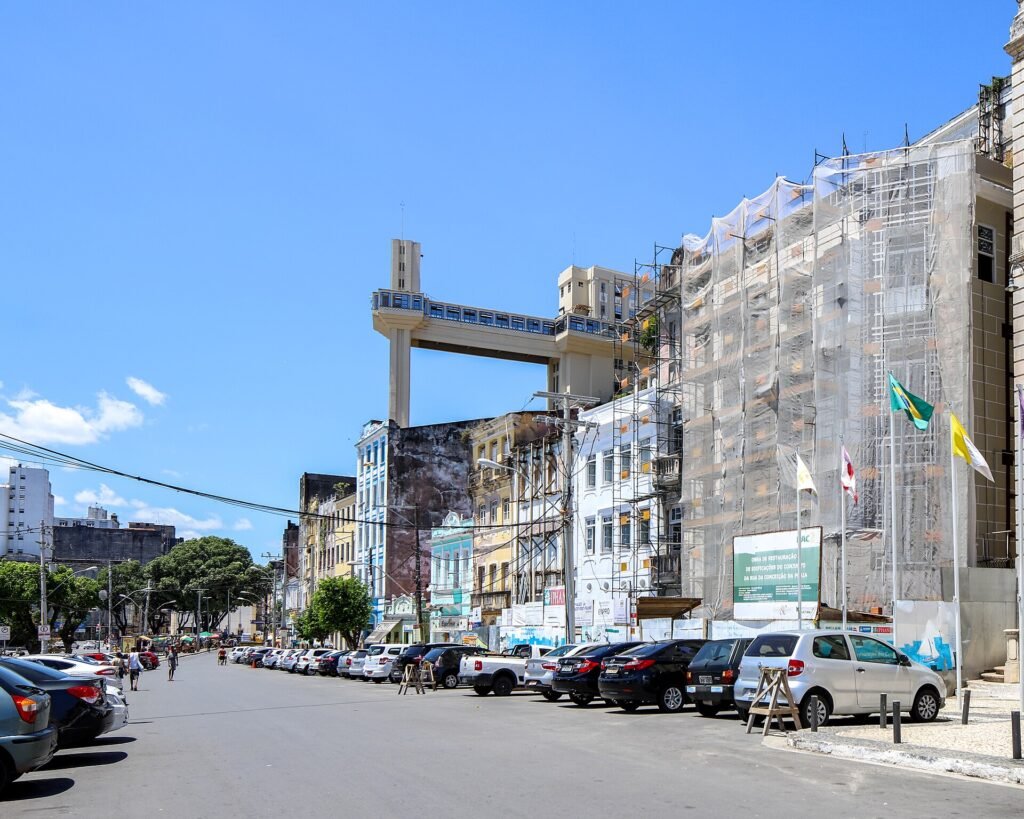
The Elevador Lacerda, opened on December 8, 1873, links Praça Tomé de Souza in the upper city to the Comércio district in the lower city. Its two-tower structure stands 236 ft (72 m) tall. It runs Monday to Friday from 6:30 a.m. to 9:30 p.m., and from 7 a.m. to 9:30 p.m. on weekends and holidays, according to the city’s mobility department (March 2026).
At the foot of the elevator, the Mercado Modelo, renovated in late 2023, has 263 shops on two floors. City pages give three versions of its hours, with closing between 4 p.m. and 7 p.m. on weekdays and at 2 p.m. on Sunday. The Plano Inclinado Gonçalves, a free funicular, also links Comércio to Pelourinho, from 7 a.m. to 6 p.m. on weekdays and 7 a.m. to 1 p.m. on Saturday.
Where sources disagree: when the Elevador Lacerda reopened in February 2025, after ten months of work, a fare of R$1 per ride was announced. In May 2026, however, the city said access remained free for residents and tourists alike. Keep a coin on you just in case.
Barra: the lighthouse, the forts and Porto da Barra beach
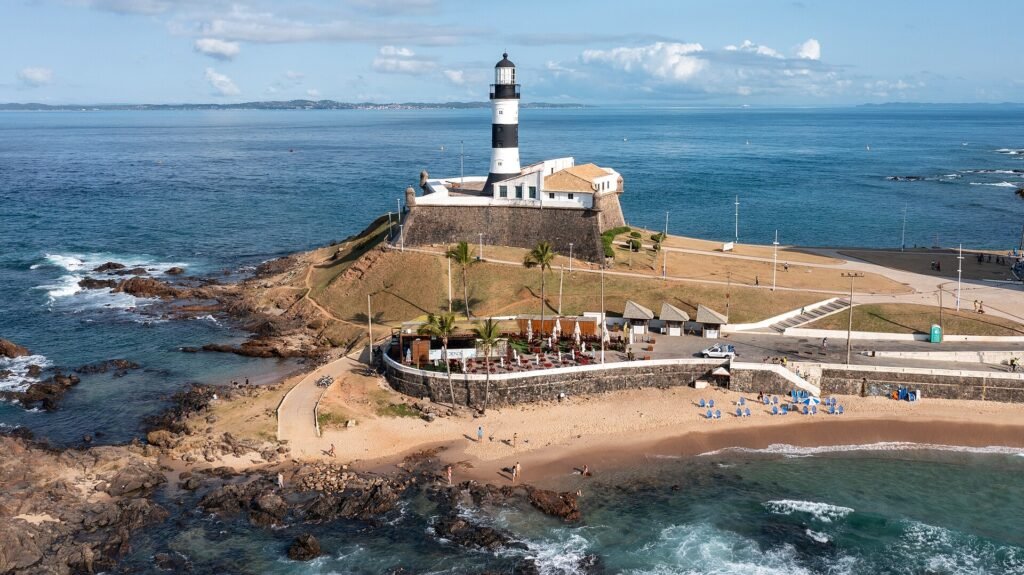
- Farol da Barra: the Santo Antônio fort, which its museum presents as the oldest military building in Brazil (1530s), has carried a lighthouse since 1698. The current tower, 72 ft (22 m) tall, dates from 1839. It houses the Museu Náutico da Bahia: R$20, R$10 at the half-price rate, last entry at 5:30 p.m.
- Santa Maria and São Diogo forts: they host the Pierre Verger and Carybé exhibition spaces, open Wednesday to Monday from 10 a.m. to 6 p.m., for R$20 or R$10.
- Porto da Barra: the beach the tourism board recommends for calm-water swimming.
Rio Vermelho, Bonfim and beyond
- Rio Vermelho: the district of the acarajé stands, including Dinha’s, founded in 1944 on Largo de Santana, and Cira’s, on Largo da Mariquita. The Festa de Iemanjá takes place here every February 2.
- Basílica do Senhor do Bonfim: visits Monday to Thursday and Saturday from 7 a.m. to 6 p.m., Friday and Sunday from 5:30 a.m. to 6 p.m., according to the tourism board (March 2026).
- Museu de Arte Moderna (MAM), Solar do Unhão: Tuesday to Sunday from 10 a.m. to 6 p.m., according to Bahia’s heritage institute. A city page gives a 1 p.m. opening.
- Dique do Tororó: a lake dotted with Tati Moreno’s sculptures of orixás, facing the Arena Fonte Nova stadium.
- Itapuã: an 1823 lighthouse, 69 ft (21 m) tall, and Abaeté Park, 556 acres (225 hectares) of lagoons and dunes near the airport.
Guided walks in Pelourinho and boat trips you can book ahead
Our partner GetYourGuide sells the activities below online. For a historic-center tour, check the end time: the neighborhood guidance above advises against being there on foot after dark.
Where to stay in Salvador: three areas and their trade-offs
The choice comes down to the historic center, Barra and Rio Vermelho. Evening safety is the main criterion: the historic center means taking a car after dark, while Barra is the only district France’s foreign ministry singles out. Our article on where to stay in Salvador de Bahia covers each neighborhood in detail.
Historic center: sleep in a heritage building, steps from the churches
Hotel Villa Bahia, on Largo do Cruzeiro de São Francisco, has 17 rooms in two colonial mansions from the 17th and 18th centuries, with a pool in a courtyard.
On Rua Chile, the Fera Palace Hotel occupies an Art Deco building that opened in 1934, with a rooftop infinity pool. On Praça Castro Alves, Hotel Fasano Salvador has 70 apartments in the former headquarters of the newspaper A Tarde.
Barra: on the beach, in the one district singled out as an exception
The Grande Hotel da Barra, on Rua do Forte de São Diogo, has 121 apartments and a pool, in front of Porto da Barra beach. On Avenida Oceânica, the Monte Pascoal Praia Hotel lists 80 apartments with a balcony and an ocean view, plus a heated pool.
Rio Vermelho: between Barra and the airport, near the acarajé stands
The Mercure Salvador Rio Vermelho is 12 miles (20 km) from the airport, 4 miles (6.5 km) from the Farol da Barra and 5.8 miles (9.4 km) from the Elevador Lacerda, according to its listing. The Novotel Salvador Rio Vermelho is 5.6 miles (9 km) from Pelourinho. Both have a pool facing the ocean.
Before you book: the Pestana Convento do Carmo, still recommended in many guides, stopped operating in April 2020. Local press described it as still closed in April 2026.
The map below shows available stays across the city, with rates for the dates you choose.
See recent prices and reviews for stays in Salvador
Islands and day trips from Salvador: Itaparica, Morro de São Paulo, Praia do Forte
- Itaparica by ferry: from the São Joaquim terminal to Bom Despacho, the crossing takes 60 to 80 minutes, with one departure an hour. Foot passengers pay R$7.20 on weekdays and R$9.50 on weekends and holidays, the fare in force since March 6, 2026.
- Mar Grande by launch: boats leave from the Terminal Náutico, near the Mercado Modelo. We could not find the official 2026 fare.
- Morro de São Paulo: about 2 hours 20 minutes by catamaran from the Terminal Náutico. The operator Biotur lists departures at 9 a.m. and 2:30 p.m., and the island charges a R$50 fee on arrival. Fares change with the season: check its schedule page.
- Ilha dos Frades: about an hour by schooner from the Terminal Náutico, with a R$10 preservation fee on landing.
- Praia do Forte: about 47 miles (75 km) away via the Estrada do Coco. The Projeto Tamar visitor center, dedicated to sea turtles, opens Tuesday to Sunday from 11 a.m. to 5 p.m.: R$54, R$27 at the half-price rate.
- Cachoeira: a town listed as a national monument, about 75 miles (120 km) away.
Salvador weather by month: hot all year, wettest from April through July
Afternoon highs run from 80 to 88°F all year, and no month is truly dry. From April through July, 7.6 to 11.9 inches of rain fall each month, over 16 to 19 days. December is the driest month, with 2.5 inches over 7 days.
- Jan 3.0 in
- Feb 3.9 in
- Mar 5.8 in
- Apr 11.2 in
- May 11.9 in
- Jun 9.4 in
- Jul 7.6 in
- Aug 5.1 in
- Sep 3.9 in
- Oct 3.6 in
- Nov 4.3 in
- Dec 2.5 in
Average rainfall by month, 1991-2020 normals. Yellow: under 4 inches. Light blue: 4 to 6 inches. Dark blue: more than 6 inches.
| Month | Low / high | Rain (rainy days) |
|---|---|---|
| January | 75 / 88°F | 3.0 in (9) |
| February | 75 / 88°F | 3.9 in (9) |
| March | 75 / 88°F | 5.8 in (11) |
| April | 74 / 85°F | 11.2 in (16) |
| May | 73 / 83°F | 11.9 in (18) |
| June | 71 / 81°F | 9.4 in (19) |
| July | 70 / 80°F | 7.6 in (18) |
| August | 70 / 80°F | 5.1 in (16) |
| September | 71 / 82°F | 3.9 in (11) |
| October | 73 / 84°F | 3.6 in (8) |
| November | 74 / 86°F | 4.3 in (8) |
| December | 74 / 87°F | 2.5 in (7) |
These rounded figures are the 1991-2020 climate normals from Brazil’s National Institute of Meteorology (INMET), as reproduced by Wikipedia, converted from Celsius and millimeters. They are not a forecast. We cross-checked April and October against two INMET bulletins. Salvador gets about 72 inches of rain a year.
Carnival, Iemanjá, Bonfim: the 2027 dates
- Lavagem do Bonfim: Thursday, January 14, 2027. The procession, held on the second Thursday after Epiphany, covers 5 miles (8 km) to the basilica.
- Festa de Iemanjá: Tuesday, February 2, 2027, in Rio Vermelho.
- Carnival: Thursday, February 4 through Tuesday, February 9, 2027, with pre-Carnival events from January 29, according to the city’s calendar as reported by local press. The Barra-Ondina circuit runs 2.8 miles (4.5 km).
- São João: in June. The 2026 edition ran June 19 to 24, centered on Pelourinho. The 2027 dates have not been published yet.
Health, insurance and practical details
The CDC’s Yellow Book 2026 chapter on Brazil is the basis for the points below. We could not open the CDC destination page for Brazil on the day we wrote this, so check it, or a travel clinic, for the current vaccine list.
- Yellow fever: the vaccine is recommended for a list of states and for “designated areas of Bahia.” The chapter did not let us determine whether Salvador is inside those areas: ask a travel clinic.
- Malaria: Bahia is not among the states where the Yellow Book reports malaria transmission.
- Dengue: the most common mosquito-borne virus in Brazil, the chapter says. A Level 1 CDC notice on Oropouche in the Americas also lists Brazil. Protect yourself against mosquito bites.
- Hepatitis A: vaccination is recommended.
- Water: avoid untreated water. Schistosomiasis is present in fresh water in the Northeast, the chapter notes, while swimming in salt water carries no such risk.
For medical coverage abroad, our partner SafetyWing sells Nomad Insurance Essential, paid every 4 weeks. Its page lists up to $250,000 in medical coverage and a $100,000 lifetime maximum for emergency evacuation. It excludes pre-existing conditions, maternity and cancer treatment, and coverage in your home country is limited. Readers who live in Europe can look at Chapka’s Cap Assistance 24/24 instead.
Reader perk: with the code ADVISEDTRAVELER, travelers who have never had a SafetyWing account get 8 weeks of the Electronics Theft add-on at no charge, on Nomad Insurance Essential bought as a 28-day subscription or an annual plan. Click the pink camera on the Nomad Insurance page and enter the code before you create your account. After the 8 weeks, the add-on renews as a paid option.
- Power: Salvador runs on 127 V at 60 Hz, unlike the rest of Bahia, which uses 220 V. Outlets are type N, with round pins, so US flat-blade plugs need an adapter. Check that your chargers are rated 100-240 V.
- Mobile data: our partner Yesim sells country data plans as eSIMs. Check on its site that Brazil is covered, and at what price, before you buy.
Salvador, Brazil: frequently asked questions
How many days do you need in Salvador?
Three days cover the city’s three main areas: the historic center and the Elevador Lacerda, Barra and its forts, then Rio Vermelho and Bonfim. Add a day for each excursion: the Itaparica ferry takes 60 to 80 minutes, and the catamaran to Morro de São Paulo about 2 hours 20 minutes each way.
Is Salvador, Brazil safe for tourists?
The State Department rates Brazil Level 2, Exercise Increased Caution, citing crime and kidnapping. France’s foreign ministry describes strong insecurity across nearly all of Salvador, with Barra as the possible exception, and says Pelourinho and Santo Antônio should be avoided on foot after nightfall.
How do you get from Salvador airport to Pelourinho?
By metro, for R$4.10: take the free shuttle from the terminal to Aeroporto station, ride Line 2 to Acesso Norte, then Line 1 to Campo da Pólvora, half a mile (800 m) from Pelourinho. Accredited taxis and rideshares also serve the airport, which is 17 miles (28 km) from downtown.
What is the best way to get around Salvador?
The metro covers the airport and the edge of the historic center from 5 a.m. to midnight, and the Elevador Lacerda links the upper and lower city until 9:30 p.m. Uber and 99 operate in the city. The State Department advises against municipal buses.
Do Americans need a visa to visit Salvador?
Yes. US citizens need a visa to enter Brazil. The official e-visa portal lists a fee of $80.90, processing of up to 10 business days and stays of up to 90 days per year.
Is the São Francisco church in Salvador open?
No. It has been closed to visitors since part of its ceiling collapsed on February 5, 2025. The Franciscan order is aiming to reopen in 2029, funding permitting.
When is the best time to visit Salvador?
From September through February, the 1991-2020 normals show 2.5 to 4.3 inches of rain a month, against 7.6 to 11.9 inches from April through July. Temperatures barely change, with highs of 80 to 88°F.
Crossings, islands and tours for your travel dates
Catamaran and schooner operators change their timetables with the season. The selection below, kept current by GetYourGuide, shows excursions you can book with transportation included.
Sources
All sources were consulted on October 11, 2026. Where we could not verify a piece of information, we said so in the text instead of publishing it.
- US government: State Department, Brazil travel advisory (issued August 31, 2026); CDC Yellow Book 2026, Brazil. Brazilian e-visa: brazil.vfsevisa.com.
- City of Salvador (in Portuguese): Largo do Pelourinho, Terreiro de Jesus, Catedral Basílica, Rosário dos Pretos, Ordem Terceira de São Francisco, Elevador Lacerda, Santo Antônio Além do Carmo, Pelourinho tourist police; elevator hours (March 11, 2026), free access to the Elevador Lacerda, 2026 bus fare.
- Salvador tourism board, salvadordabahia.com (in Portuguese and English): churches, cultural venues, Mercado Modelo, Rio Vermelho, lighthouses, islands.
- Venue websites (in Portuguese): Fundação Casa de Jorge Amado, Museu Náutico da Bahia, museums of Bahia’s heritage institute (IPAC), Projeto Tamar.
- São Francisco church (in Portuguese): Bahia Notícias (July 21, 2026) and Correio (July 22, 2026).
- Transportation: Salvador Bahia Airport (about the airport, destinations, getting there), Bahia metro (fares, hours and luggage, Campo da Pólvora station), State of Bahia, new bus terminal, Internacional Travessias, Itaparica ferry, Biotur, Morro de São Paulo catamaran, Uber and 99.
- Neighborhood safety guidance (in French): France Diplomatie, travel advice for Brazil. Bahia Civil Police (in Portuguese): DELTUR Barra, DELTUR airport.
- 2027 calendar (local press, in Portuguese): Correio, Carnival, Jornal Grande Bahia, Lavagem do Bonfim, A Tarde, São João 2026.
- Hotels, official websites: Hotel Villa Bahia, Fera Palace Hotel, Hotel Fasano Salvador, Grande Hotel da Barra, Mercure Salvador Rio Vermelho, Novotel Salvador Rio Vermelho. Monte Pascoal Praia Hotel: the hotel’s booking engine. Pestana Convento do Carmo: Anota Bahia (April 2, 2026).
- Also: IBGE for population; UNESCO, Historic Centre of Salvador de Bahia; Wikipedia, Salvador, Bahia for the INMET climate normals, and Salvador (in Portuguese) for the elevation difference; World Standards for voltage and outlets.
Read next: where to stay in Salvador de Bahia and our Brazil travel guide.
Written by the Advised Traveler team. Hours, prices, entry rules and safety guidance change: check them with the sources above before you go. Spotted an error? Contact us.