
Things to Do in Beirut: Museums, the Corniche, a Byblos Day Trip and When to Go
Opening days and admission straight from three Beirut museums, the World Bank’s climate summary for Lebanon, and UNESCO’s description of Byblos.
- 1942 National Museum opens
- Free admission at the Sursock Museum
- 25 miles north to Byblos
- 95°F+ on the coast in August
Beirut is a museum city first: Lebanese history from the Stone Age onward sits within a few neighborhoods, and the seafront Corniche is the classic walk afterward. Below, you’ll find the hours, prices and rules each venue publishes for itself.
Byblos, a UNESCO World Heritage site, is the closest day trip. Timing a visit mostly comes down to summer heat and winter rain, both covered further down.
Check the advisory first: conditions in Lebanon can shift quickly. Read the State Department’s Lebanon Travel Advisory before you book, and again a few days before departure.
Advised Traveler is free to use. If you find our content useful, you can support us by booking through our affiliate links: we earn a commission at no extra cost to you.
- Top things to do
- Best time to visit
- National Museum of Beirut
- Sursock Museum
- Museum of Lebanese Prehistory
- Day trip to Byblos
- Where to stay
- Insurance and phone data
- FAQ
- Sources
What are the top things to do in Beirut?
- National Museum of Beirut: more than 1,300 archaeological pieces, from prehistory to the Mamluk era.
- Sursock Museum: free entry in Ashrafieh, Wednesday through Sunday.
- Museum of Lebanese Prehistory: run by Saint Joseph University, open weekdays except Monday.
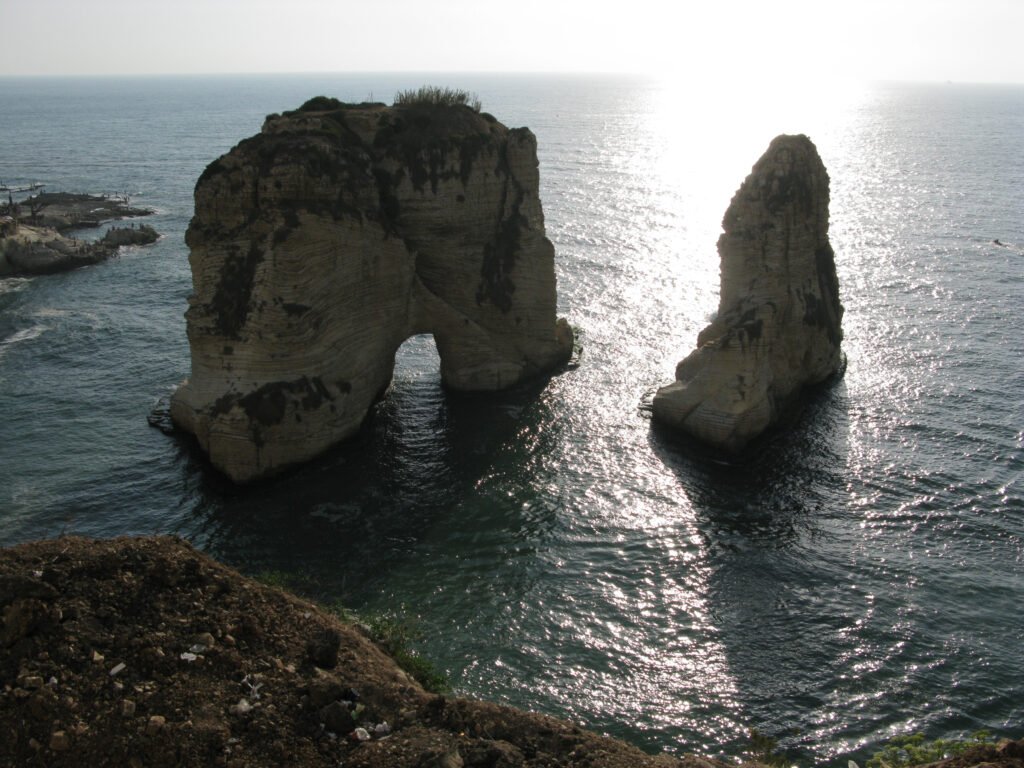
- The Corniche and Raouche Rocks: the seafront and the twin rock formations pictured at the top. Our partner’s hop-on hop-off city tour stops along this stretch.
- Downtown on foot: a guided walk through Downtown, the Roman Baths and Martyrs’ Square covers the city center in one go.
GetYourGuide lists its Beirut tours below. Before you book a guided walk, check where it starts and whether museum tickets are included, since only Sursock is free.
See all Beirut tours and activities on GetYourGuide
When is the best time to visit Beirut?
April, May and October are your best bets: they fall between the hot, humid summer and the rainy winter. The World Bank’s Climate Change Knowledge Portal describes Lebanon’s climate as Mediterranean, with hot, dry summers from June to September and cool, rainy winters from December to mid-March.
| Season | What to expect |
|---|---|
| June to Sept. | Hot and humid on the coast, above 95°F in August |
| Nov. to March | About 70% of Lebanon’s yearly rain |
| January | Coldest month, roughly 41 to 50°F nationwide |
Keep in mind: these are country-level figures, not readings from a Beirut weather station. On the coast, annual rainfall runs 28 to 39 inches, so a winter trip means packing for wet days.
Day of the week matters too. Wednesday, Thursday and Friday are the only days when both Sursock and the Museum of Lebanese Prehistory are open.
National Museum of Beirut
Lebanon’s main archaeological museum opened in 1942 in a Neo-Egyptian building. It was heavily damaged during the civil war and needed a full renovation inside and out. Wilmotte & Associés, the firm behind the exhibition design, dates the phased work to 2000.
Two floors display more than 1,300 pieces spanning prehistory through the Mamluk period, useful background before the Byblos day trip.
Hours and tickets: neither appears on the architect’s project page. Ask your hotel the day before you go.
Sursock Museum: hours, admission and house rules
The Sursock Museum stands on Greek Orthodox Archbishopric Street in Ashrafieh. Its “Plan Your Visit” page lists hours of 10 a.m. to 6 p.m., Wednesday through Sunday, and admission is free.
- Bags: anything larger than about 18 x 14 x 8 inches goes to the cloakroom.
- Cameras: no flash, personal use only, and no tripods.
- Food: only on the esplanade or in the museum restaurant.
- Pets: not allowed on the grounds.
Museum of Lebanese Prehistory at Saint Joseph University
This university museum sits on Saint Joseph University Street in the Monnot area of Ashrafieh, the same district as Sursock. It opens Tuesday to Friday, 8:30 a.m. to 4:30 p.m., and closes on national holidays and during vacations. Groups of 12 or more need a reservation on Saturdays.
| Ticket | Price |
|---|---|
| Full price | 150,000 LBP |
| Students under 26 | 100,000 LBP |
| Workshop, full price | 500,000 LBP |
Is Byblos worth a day trip from Beirut?
If ancient history is why you came, yes. UNESCO places Byblos on a sandstone cliff about 40 km (25 miles) north of Beirut and calls it continuously inhabited since Neolithic times, starting with a fishing community some 8,000 years ago.
The layers run from Bronze Age temples and Persian fortifications to a Roman road, Byzantine churches, a Crusader citadel and the medieval and Ottoman town. UNESCO also highlights the inscription on the Ahiram sarcophagus. Without a car, a group day tour combining Jeita Grotto, Harissa and Byblos leaves from Beirut.
Outside the capital: the State Department advisory can treat some areas of Lebanon differently from Beirut. Check your route against it before heading out.
Where to stay in Beirut
Our guide Where to Stay in Beirut? compares the neighborhoods. If museums are your focus, a base in Ashrafieh keeps Sursock and the prehistory museum close; the map shows listings across the city.
Compare Beirut hotels with recent prices and reviews
Travel insurance and phone data for Lebanon
Entry requirements, health guidance and safety updates for U.S. citizens are on the Lebanon advisory page. With an advisory that can change at short notice, look for a policy that covers medical evacuation.
SafetyWing Nomad Insurance is one option; its quote page shows whether a trip to Lebanon is eligible for your dates and country of residence. Readers living in Europe can also look at Chapka’s Cap Assistance 24/7 plan. For data, confirm Lebanon is on the coverage list before buying a Yesim eSIM.
More Beirut tours
Many day trips leave Beirut early and pack several stops into one day. Compare the return time and what’s included (entry fees, lunch) before you pick one.
Beirut FAQ
Is the Sursock Museum free?
Yes. Entry is free, Wednesday through Sunday, 10 a.m. to 6 p.m.
How hot is Beirut in summer?
Hot and humid on the coast, with temperatures above 95°F in August according to the World Bank’s climate portal.
How far is Byblos from Beirut?
About 25 miles north, per UNESCO, an easy day trip.
Is it safe to travel to Beirut right now?
Go by the State Department’s current Lebanon advisory, checked when you book and again right before you leave.
Sources
All checked on November 17, 2026.
- Sursock Museum, Plan Your Visit.
- Saint Joseph University, Museum of Lebanese Prehistory, practical information.
- Wilmotte & Associés, National Museum of Lebanon.
- UNESCO World Heritage Centre, Byblos.
- World Bank, Climate Change Knowledge Portal, Lebanon: Current Climate (1991-2020 climatology).
Compiled by the Advised Traveler team from the sources above; we did not visit in person. Spotted a change in hours or prices? Let us know.