
Morocco Travel Guide: Where to Go, Best Time to Visit, Entry Rules for Americans and Getting Around
Passport and visa rules for U.S. citizens, the regions and our city guides, Marrakech and Tangier weather in °F, the high-speed train, cash rules and local laws.
- 90 days visa-free for U.S. passport holders
- Level 2 State Department advisory since September 4, 2026
- 9 UNESCO World Heritage Sites
- 100°F average July high in Marrakech
Most first trips to Morocco pair Marrakech with one other region: the old imperial cities of Fes and Meknes, the Atlantic coast at Essaouira, or the kasbahs and Sahara dunes on the far side of the High Atlas. This guide links to our 18 English city guides for the country and to our where-to-stay articles.
Entry, money and safety details come from the State Department’s Morocco page, with the advisory dated September 4, 2026; heritage sites from UNESCO; weather from published airport normals. Everything was checked on October 15, 2026.
Advised Traveler is free to use. If you find our content useful, you can support us by booking through our affiliate links: we earn a commission at no extra cost to you.
- Visa and passport
- Where to go
- Best time to visit
- Trains and driving
- Cash and dirhams
- Where to stay
- Tours
- Health, insurance, local laws
- FAQ
- Sources
Do Americans need a visa for Morocco?
No, not for visits of 90 days or less. Your passport must have at least six months of validity when you arrive and one blank page for each entry stamp. No vaccinations are required to enter.
Staying longer: if you overstay 90 days without requesting an extension, the State Department says you will have to appear before a judge before you can leave, and a fine may apply.
Morocco is at Level 2, “Exercise increased caution,” because of the risk of terrorism. Customs also restricts drones, which need prior government authorization and are otherwise confiscated, as well as satellite phones.
Where to go in Morocco: six regions and our city guides
Seven of Morocco’s nine World Heritage Sites are old medinas or historic towns, which is why most itineraries move from city to city. The cards below group our guides by region.
Marrakech
The medina has been on the UNESCO list since 1985, and the city is the usual base for day trips into the High Atlas and out to Essaouira. Guide: Marrakech.
Fes, Meknes and the imperial cities
The Fes medina (listed 1981), historic Meknes (1996) and the Roman ruins of Volubilis nearby (1997), plus Rabat, the capital (2012). Ifrane sits in the Middle Atlas south of Fes. Guides: Fes, Meknes, Ifrane, Rabat.
Tangier, Tetouan and the Rif
Tangier is the northern end of the high-speed line; Tetouan’s medina has been listed since 1997; Chefchaouen lies in the Rif mountains. This is the wettest part of the country in winter. Guides: Tangier, Tetouan, Chefchaouen.
The Atlantic coast
Casablanca, the southern end of the high-speed line; Essaouira, whose medina was listed in 2001; El Jadida’s Portuguese city of Mazagan (2004); then Agadir and the surf village of Taghazout. Guides: Casablanca, Essaouira (rewritten October 2026), Agadir, Taghazout.
The south: kasbahs, Sahara dunes and the Anti-Atlas
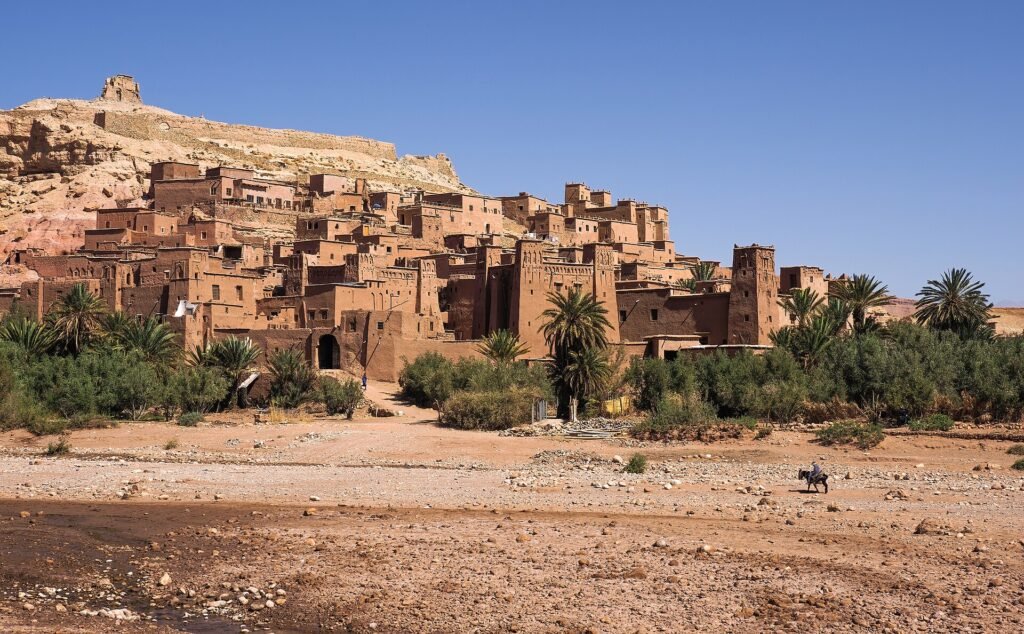
Ouarzazate and Ait Benhaddou (listed 1987) across the High Atlas from Marrakech, Merzouga at the foot of the Erg Chebbi dunes, and the walled town of Taroudant, Tiznit and Tafraoute inland from Agadir. Guides: Ouarzazate, Ait Benhaddou, Merzouga, Taroudant, Tiznit, Tafraoute.
Dakhla
A lagoon town far down the Atlantic coast, in Western Sahara. France’s foreign ministry asks travelers there to get approval from the gendarmerie or armed forces before leaving the paved coastal road. Guide: Dakhla.
When is the best time to visit Morocco?
For Marrakech and the interior, February through April and November are the comfortable months, with average highs in the 70s. From May to October, afternoons average 85°F or more, peaking near 100°F in July. Tangier on the north coast stays in the low 80s in summer but gets most of its rain from November to February.
- Jan 43 / 66°F
- Feb 46 / 69°F
- Mar 51 / 75°F
- Apr 54 / 78°F
- May 59 / 85°F
- Jun 64 / 93°F
- Jul 69 / 100°F
- Aug 70 / 99°F
- Sep 66 / 91°F
- Oct 60 / 83°F
- Nov 51 / 74°F
- Dec 45 / 68°F
Marrakech average low and high by month, 1991-2020 normals for Menara Airport. Dark blue: high below 50°F. Light blue: 50 to 67°F. Yellow: 68 to 81°F. Orange: 82°F and above.
| Month | Marrakech | Tangier |
|---|---|---|
| Jan | 43 / 66°F | 48 / 61°F |
| Feb | 46 / 69°F | 49 / 62°F |
| Mar | 51 / 75°F | 50 / 64°F |
| Apr | 54 / 78°F | 52 / 67°F |
| May | 59 / 85°F | 56 / 71°F |
| Jun | 64 / 93°F | 61 / 77°F |
| Jul | 69 / 100°F | 66 / 83°F |
| Aug | 70 / 99°F | 66 / 84°F |
| Sep | 66 / 91°F | 65 / 81°F |
| Oct | 60 / 83°F | 60 / 75°F |
| Nov | 51 / 74°F | 54 / 67°F |
| Dec | 45 / 68°F | 50 / 63°F |
| Rain per year | 8.7 in | 29.0 in |
About these numbers: Marrakech uses 1991-2020 normals; the only Tangier series in the same reference table is older, 1961-1990, from NOAA. Treat them as typical conditions, not a forecast. The State Department also warns of flooding between October and March.
Getting around Morocco: the Al Boraq high-speed train, regular trains and driving
Al Boraq, Africa’s first high-speed line, opened in November 2018 between Tangier, Kenitra, Rabat and Casablanca. At launch, the International Union of Railways put Tangier to Casablanca at 2 hours 10 minutes, down from 4 hours 45, with a top speed of 320 km/h (about 200 mph) on the new track.
Marrakech and Fes are still reached on ONCF’s conventional trains. Moroccan press reported in May 2026 that the high-speed extension from Kenitra to Marrakech was 30% complete, with opening announced for September 2029.
Renting a car: a U.S. driver’s license is valid in Morocco for up to one year. France’s foreign ministry also recommends an International Driving Permit and advises against driving at night.
Cash in Morocco: how the closed dirham works
The Moroccan dirham (MAD) is a closed currency, so you get it inside the country and can’t take it out.
- Arriving: declare foreign currency worth more than 15,000 MAD, roughly $1,500.
- Large sums: cash over 50,000 MAD needs formal paperwork if you want to export it later.
- Leaving: exporting dirhams is prohibited. Keep your exchange receipts; you need them to convert leftover dirhams back before you fly.
Where to stay in Morocco
Pick the city first, then the neighborhood. We compare areas and places to stay in Essaouira, Chefchaouen and Taghazout. For a riad or hotel elsewhere, compare current prices and reviews in Marrakech, Fes, Casablanca, Tangier, Agadir or Merzouga.
Check prices and reviews across Morocco
Morocco tours and day trips
Our partner GetYourGuide lists guided tours and day trips across the country; the button below opens the full selection. On a multi-day Sahara trip from Marrakech, check what the price covers (camp night, meals, return transfer) and when you get back, since the drive crosses the High Atlas both ways.
See all Morocco tours and activities on GetYourGuide
Health, insurance and local laws
Tap water is often unsafe; drink sealed bottled water and ask for drinks without ice. For an ambulance, dial 150 (15 from a landline), though the State Department notes a taxi to the hospital may be faster. Bring prescriptions in their original packaging.
Hospitals often want cash up front, and most U.S. health plans don’t pay abroad, so the State Department strongly recommends medical evacuation coverage. Our partner SafetyWing Nomad Insurance is open to U.S. residents; check eligibility and limits on its quote page. New customers on Nomad Essential (28-day subscription or annual) can enter code ADVISEDTRAVELER before creating an account, via the pink camera icon, for 8 free weeks of Electronics Theft cover, which then renews as a paid add-on. Readers living in Europe can also look at Chapka Cap Assistance.
To stay online without your carrier’s roaming plan, our partner Yesim sells Morocco eSIM plans you can install before you fly, if your phone supports eSIM.
- Same-sex relations are criminalized, with fines and up to three years in prison.
- Words or acts seen as offending the King, Islam or the state can lead to prosecution; proselytizing is banned.
- Photography: avoid palaces, diplomatic missions and government buildings.
- Unpaid hotel bills and bad checks can lead to jail and a seized passport.
Morocco travel FAQ
Do U.S. citizens need a visa to visit Morocco?
No, for stays up to 90 days. You need a passport valid for at least six months on arrival.
Is Morocco safe for American tourists?
The State Department rates it Level 2, “Exercise increased caution,” citing terrorism, in an advisory dated September 4, 2026.
What is the best month to visit Marrakech?
March, April and November average highs of 74 to 78°F. July averages 100°F.
Does the high-speed train go to Marrakech?
Not yet. Al Boraq ends in Casablanca; the extension to Marrakech is under construction, with opening announced for September 2029.
Can I bring Moroccan dirhams home?
No. Exporting dirhams is prohibited, so exchange what is left before departure and keep your receipts.
Can I fly a drone in Morocco?
Only with prior government authorization; otherwise customs confiscates it.
Sources
All pages checked on October 15, 2026.
- U.S. Department of State, Morocco International Travel Information (advisory dated September 4, 2026).
- UNESCO World Heritage Centre, Morocco properties (in French).
- International Union of Railways, Tangier-Casablanca high-speed line opening (in French, November 2018).
- H24info, Kenitra-Marrakech high-speed line 30% complete (in French, May 25, 2026).
- French Ministry for Europe and Foreign Affairs, Morocco travel advice (in French; driving, Western Sahara).
- Weather: Wikipedia climate tables for Marrakesh (Menara Airport, 1991-2020) and Tangier (airport, 1961-1990, NOAA).
Maintained by the Advised Traveler team. Entry rules and train schedules change, so confirm them with the State Department and ONCF before you go. Spotted an error? Let us know.